Anyone who unrolls a Japanese hanging scroll for the first time sees the painting first. Only at second glance does it become apparent how much is going on around it: a narrow strip of gold-threaded fabric above and below the image, lengths of patterned silk that frame it, calm surfaces above and below, a rod that pulls the scroll flat. None of this is the painter's doing. It is the work of a second craft, one that has been practiced in Japan for more than a thousand years and without which there would be no kakemono: hyōgu, the art of mounting.
What does hyōgu mean?
Hyōgu (表具) refers to the mounting of painting and calligraphy – everything that turns a painted or inscribed sheet into a durable object fit for display. The term hyōsō (表装) is used synonymously. It covers not only the hanging scroll, the kakemono, but also the handscroll, the folding screen (byōbu), the sliding door (fusuma), and the album. The purpose is always twofold: to preserve the work and to make it possible to show it.
The craftsman who carries out this work is called a hyōgu-shi (表具師), best rendered in English as a mounter. His profession lies somewhere between bookbinder, textile connoisseur, and conservator, and in addition to steady hands it demands a sure eye, for it is the hyōgu-shi who decides which fabric belongs to which picture. Therein lies the difference from the Western picture frame: a frame is placed around a finished picture and can be exchanged in an afternoon. A Japanese mounting is pasted to the sheet, is rolled with it, and ages with it.
From sutra scroll to tokonoma: the history of mounting
Mounting came to Japan from China together with Buddhism and began with the making up of sutra scrolls; the hanging scroll later developed from images of Buddhist deities that were hung up for devotion. As the art dictionary JAANUS records, mounting was still called sōkō in the Nara and Heian periods and was applied above all to sutras; in the Kamakura period it was carried out by professional craftsmen, the kyōji (経師). The early hanging scrolls were plainer and smaller than those of today. Medieval handscrolls show what they looked like: in the simplest case a strip of decorated silk or decorated paper at the upper and lower edge and a rod at the bottom.
Two developments gave the craft its present form. In the Muromachi period (1333–1573) it became customary to mount Chinese and Zen Buddhist painting and calligraphy in Chinese brocades. And with the shoin style of architecture came the tokonoma, the display alcove: whereas hanging scrolls had previously hung from the crossbeams of the room, they now had a fixed place. JAANUS credits the painter Geiami (1431–1485) with establishing aesthetic rules for the mounting, selection, and appreciation of hanging scrolls, from which the standard types of mounting later emerged. When the tea ceremony began to flourish from the end of the Muromachi period onward, the taste of the tea masters finally left its mark on mounting as well.
The structure of a kakemono: from honshi to jikusaki
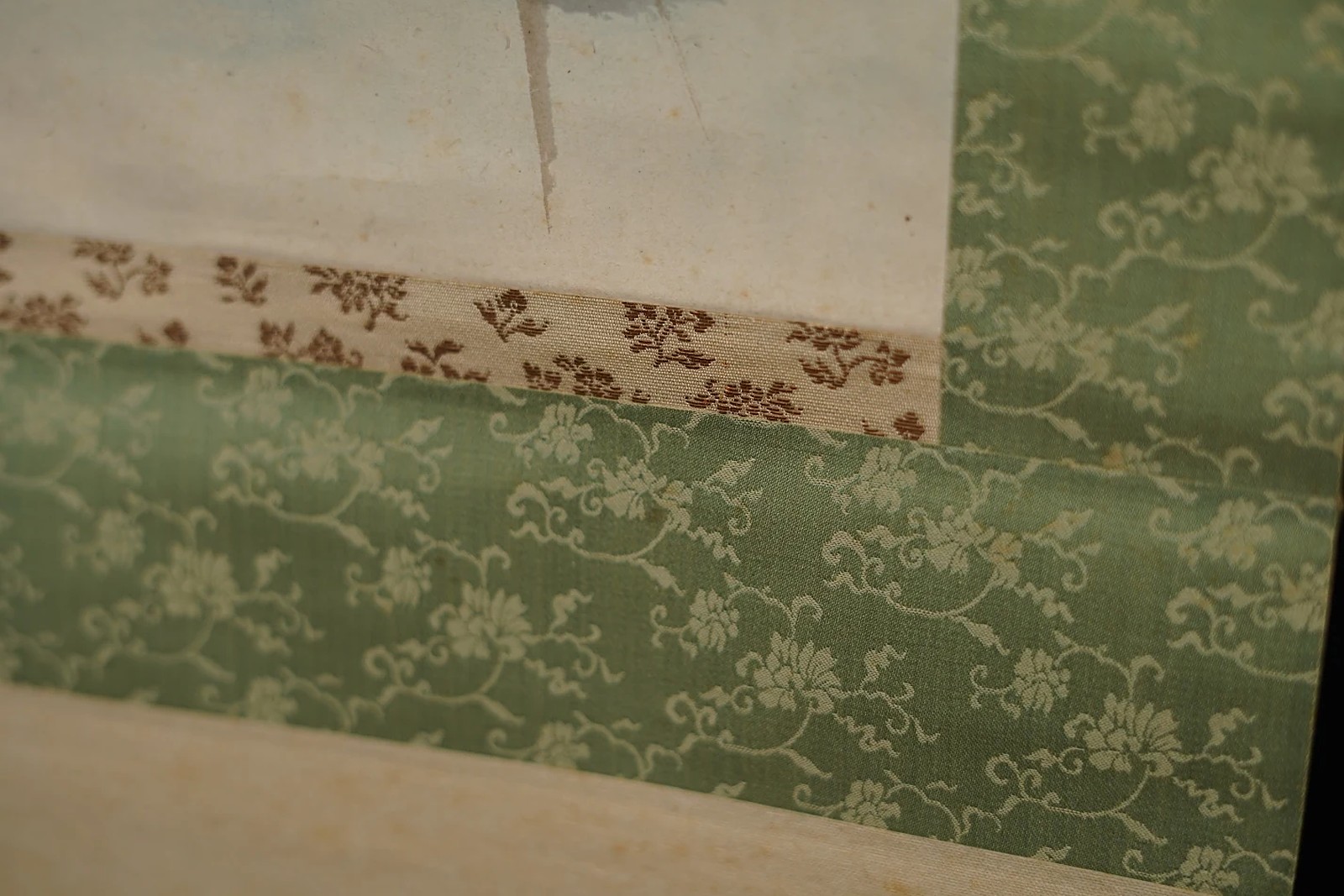
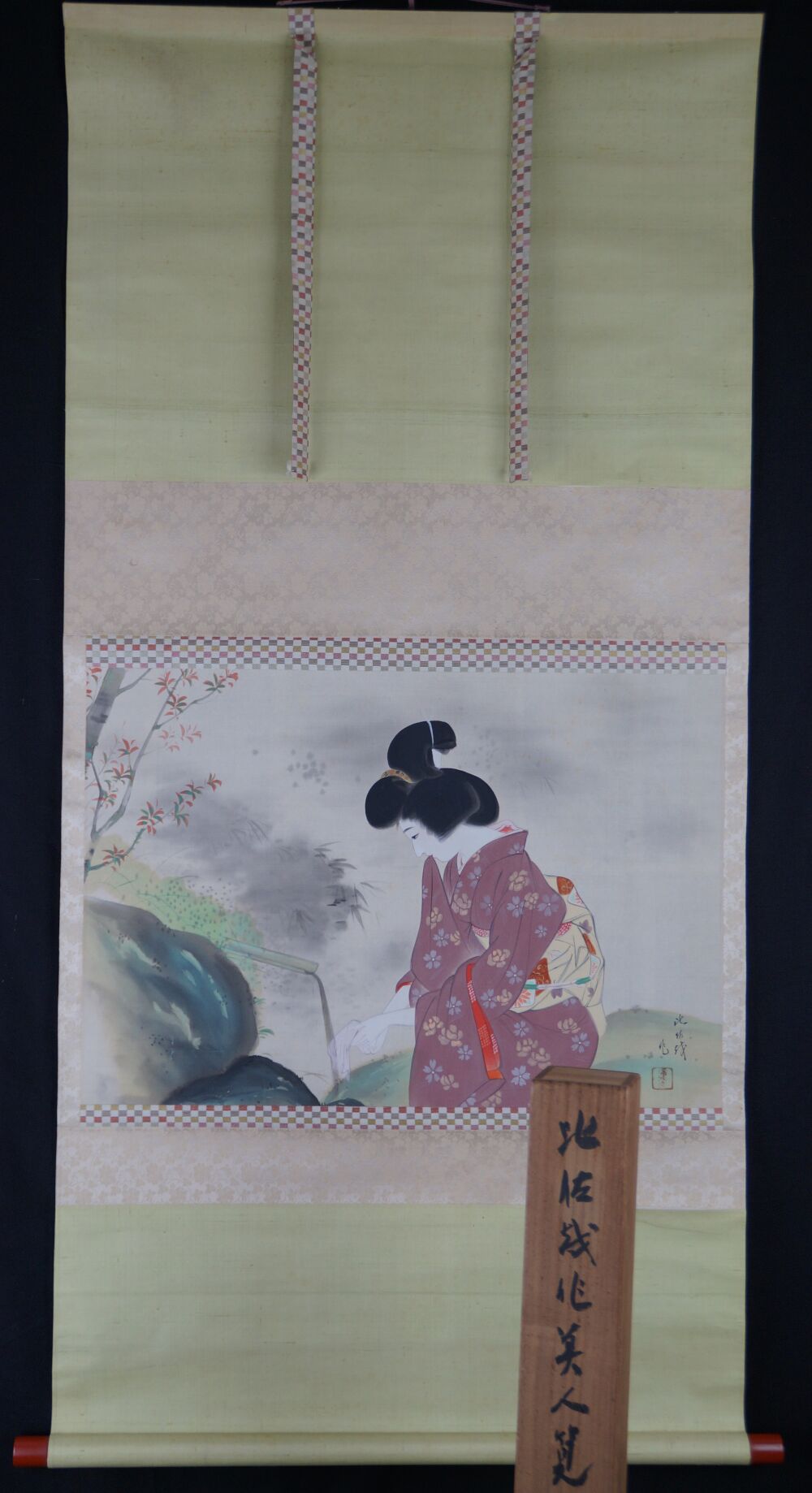
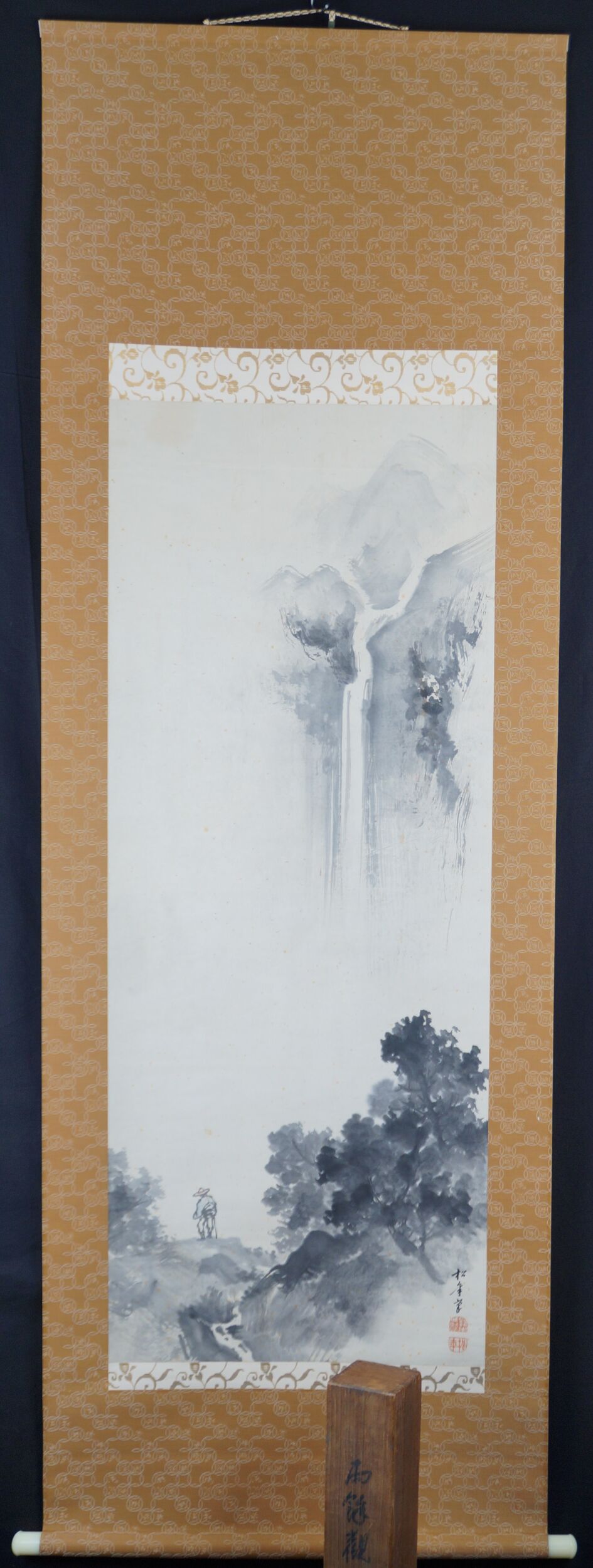
At the center sits the honshi (本紙), the actual work on paper or silk. Directly above and below it lie the ichimonji (一文字), two narrow horizontal strips, exactly as wide as the image and traditionally made of the most precious fabric in the entire mounting. Around both runs the chūmawashi (中廻し), also called chūberi: the inner border, whose side strips are called hashira, "pillars." Above and below follow the large, calm surfaces – ten (天), heaven, and chi (地), earth, together tenchi or jōge. Heaven is as a rule taller than earth.
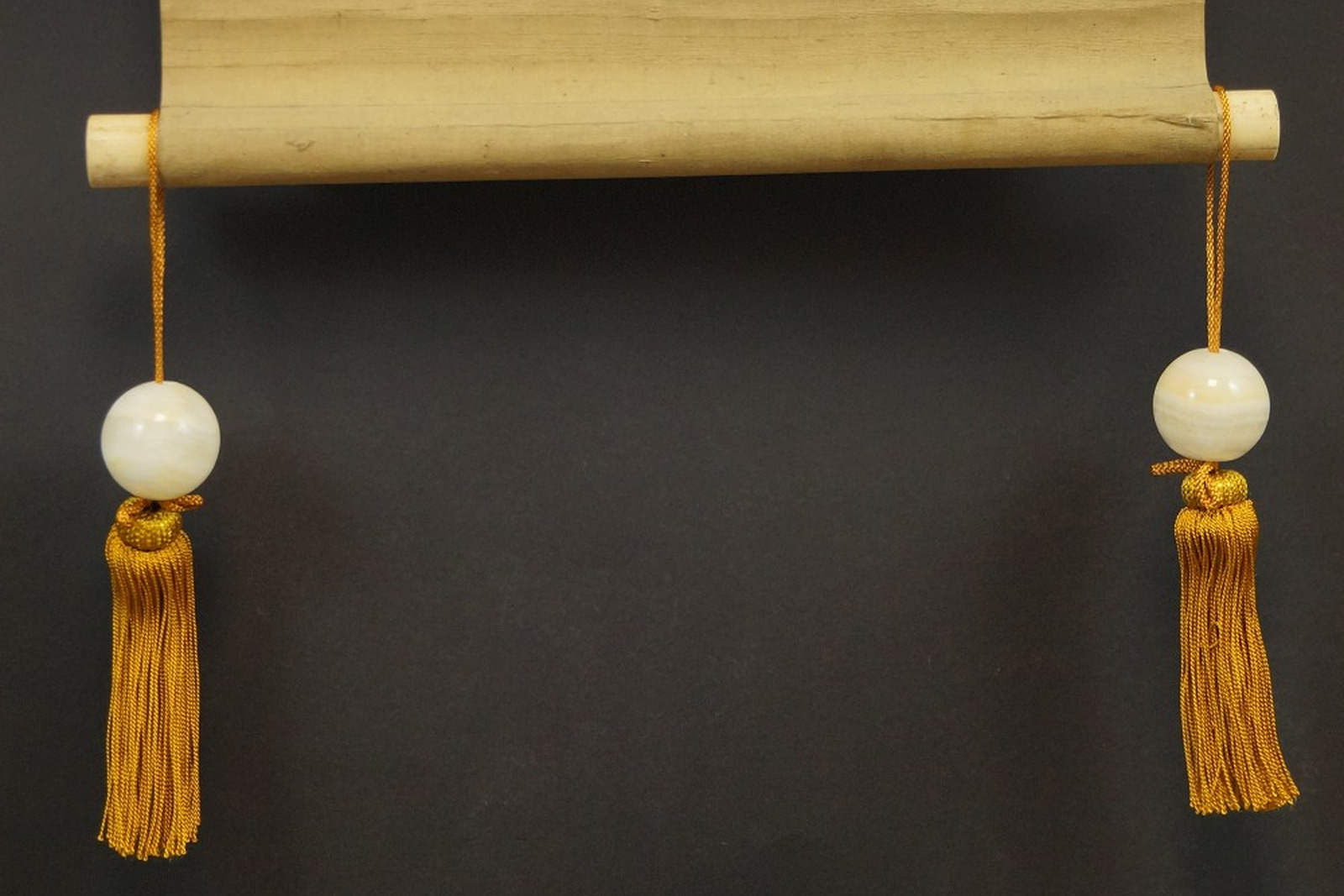
In many mountings two narrow fabric bands hang down from the upper rod, the fūtai (風帯, literally "wind bands"). They divide the field of heaven into three equal sections; in freer forms they do not hang loose but are pasted on, or they are omitted altogether. At the top, the light batten known as the hassō carries the hanging cord; at the bottom, the round rod, the jiku, pulls the scroll flat. Its visible end pieces, the jikusaki, are made of wood, bone, horn, lacquer, ceramics, or, in more recent mountings, plastic. Anyone who wants to buy an original Japanese hanging scroll therefore always holds two works in their hands: that of the painter and that of the mounter.


Shin, gyō, sō: the forms of mounting
Japanese mountings follow fixed types. The most widespread family is Yamato-hyōgu (大和表具). According to JAANUS, its hallmark is three fabrics in graded order of rank – the finest for the ichimonji, the second for the chūmawashi, the third for heaven and earth – which is why this form is also called sandan-hyōgu, "three-tiered mounting." Within the family, three degrees of formality are distinguished, named after the script styles of calligraphy: shin (真, formal), gyō (行, semi-formal), and sō (草, informal). Each degree is subdivided once more; the middle level, the "gyō of gyō," is frequently encountered today.
Alongside it stands bunjin-hyōgu (文人表具), the mounting of the literati. It spread in the Edo period with the enthusiasm for the Chinese painting of the Ming and Qing dynasties and can be recognized by its unity: a single fabric or a single paper surrounds the image on all sides. If the fūtai are also absent, one speaks of maru-hyōgu (丸表具). For Buddhist devotional images, finally, there is a separate, especially formal mounting. The form a hanging scroll bears therefore says less about its value than about its genre and the occasion for which it was intended.
Urauchi: how a hyōgu-shi works with paper, paste, and patience
The work of the hyōgu-shi begins with water and paste. A sheet of paper or silk alone would not survive constant rolling and unrolling; it is therefore reinforced from behind with washi. This backing is called urauchi (裏打ち) and is done in several passes. First, the image and each fabric individually receive a first, thin layer directly on the reverse, the hada-urauchi, literally the "skin lining." A second layer follows, the mashi-urauchi, which provides additional strength. Between the steps, each part is stretched damp onto a drying board, where it dries flat and taut.
Only then are the parts joined, in a fixed order from the image outward: ichimonji, hashira, the remaining parts of the chūmawashi, and finally heaven and earth. This step is called tsukemawashi. Last of all, a continuous backing layer is applied over the whole, the sō-urauchi, which is beaten on with a heavy pounding brush, the uchibake. The edges of the lining papers are not cut but torn while damp, so that the fibers taper off and no ridge shows through on the front.
The adhesive is wheat starch paste, which holds firmly and yet can be released again with water. After drying, the mounter fits the batten and the round rod and sews on the fūtai with silk thread. Finally, he lets the scroll down slowly by the rod ends and checks from some distance whether it hangs straight. Because the work is repeatedly moistened and dried between the stages, none of it can be hurried.
Toriawase: the choice of fabrics
Technique is only one half of the craft. The other is called toriawase (取り合わせ), the combining of the fabrics, the kireji (裂地). Ichimonji, chūmawashi, and tenchi are chosen so that they harmonize with one another, set off the image, and suit both the period in which it was made and the use to which it is put. A mounter must therefore be able to read what lies before him: whether a calligraphy bears a Zen phrase or a congratulatory poem, whether a landscape means late autumn or the first days of spring.
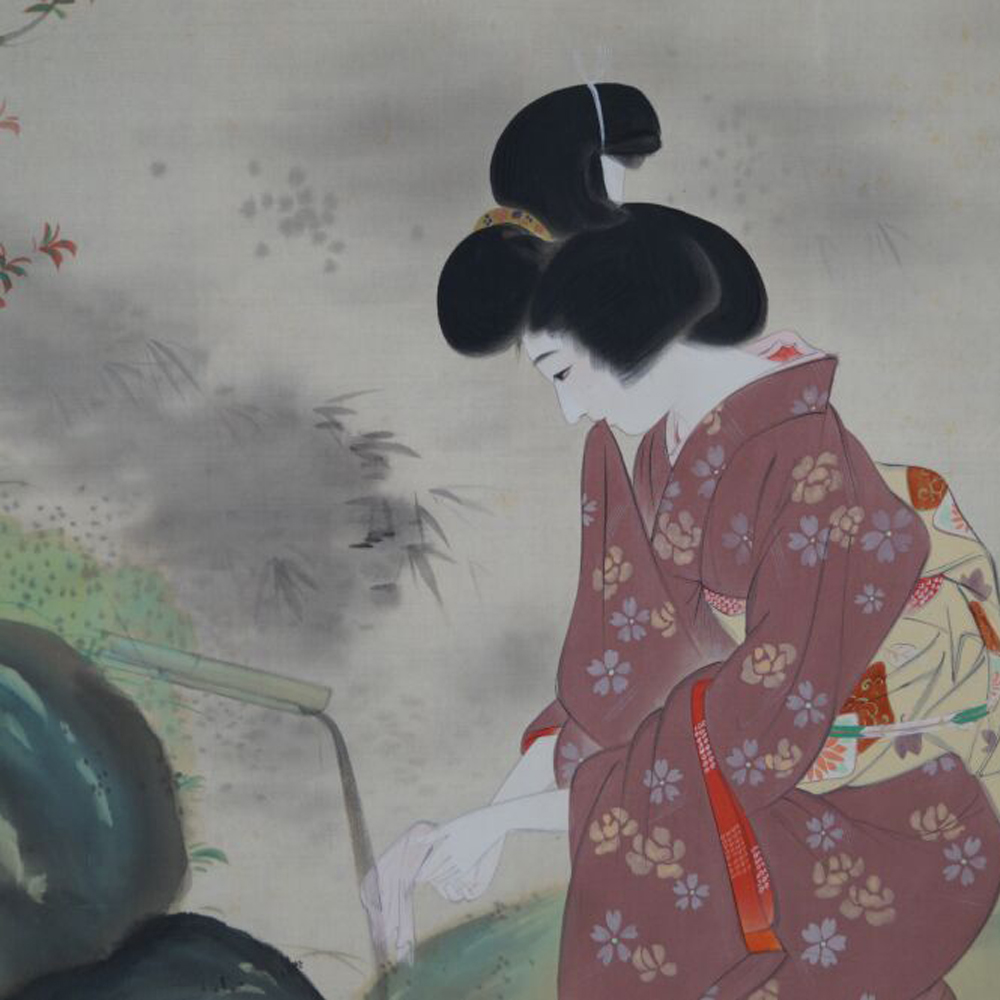
In practice, this gives rise to quiet correspondences. A cool blue-gray picks up the tone of an ink landscape, a warm golden ocher answers peonies, a scrolling vine pattern in the brocade softly repeats the movement of a branch. The ichimonji often provide the only highlight, a finger-wide strip with woven blossoms or gold threads. The Kyōto mounter Yamamoto Yukio, quoted by the Japanese register of traditional crafts, describes the ideal of his craft as something that is not too conspicuous and that one can nevertheless look at for a long time without growing tired of it. Anyone who wants to buy Japanese calligraphy should therefore deliberately look at the sheet together with its mounting for once: the fabric often explains how the mounter read the writing.

Kyō-hyōgu and Edo-hyōgu: two recognized craft traditions
For centuries the center of mounting was Kyōto, the city of the court, the temples, and the tea masters. The tradition there, Kyō-hyōgu (京表具), goes back to the Heian period according to the Japanese register of traditional crafts and has been officially recognized as a traditional craft since 1997. Besides the city's cultivated taste, its climate also favored it: the humid air of the Kyōto basin suits work with paper and paste. To this day, handmade washi and fabrics woven from natural fibers are prescribed.
A second recognized tradition is Edo-hyōgu (江戸表具) from Tokyo. It arose in the early 17th century, when, with the establishment of the shogunate, the mounters of the feudal lords, temples, and shrines also settled in Edo, and it has held the same recognition since 2020. Having emerged from the culture of the warrior class, it is regarded as restrained and light in design and at the same time robust enough for the drier climate of the city. Both traditions produce not only hanging scrolls but also handscrolls, folding screens, sliding doors, and framed pictures.
Why hanging scrolls are remounted
A mounting is not made for eternity, and that is intentional. Silk becomes brittle over the decades, paste weakens, rolling leaves creases. Because the starch paste remains water-soluble, however, the honshi can be released from its old paper layers, cleaned, backed anew, and set in a new mounting. In Japan, such an intervention is traditionally expected after roughly a century, sometimes considerably later. It is the reason hanging scrolls from earlier periods have survived at all – and why the mounting of an old painting is often younger than the painting itself. That is no flaw, but rather a sign that someone considered the work worth caring for.
Museums, too, treat the mounting as part of the work. The Cleveland Museum of Art, by its own account one of only six institutions in North America with expertise in the conservation of East Asian paintings, emphasizes that it is not just the painting that is of importance but also the mounting that surrounds it. Anyone who wants to buy an antique kakemono therefore does best to read image and mounting as two things, each with its own history. And anyone who acquires a makuri, an unmounted sheet, still has the decision about form and fabrics ahead of them.
The second hand in a hanging scroll
Hyōgu is a craft that holds itself back. As a rule the mounter does not put his name to the work, and yet he is present in every kakemono: in the width of the ichimonji, in the tone of the brocade, in the way the scroll still unrolls softly and without resistance after decades. Anyone who has once noticed this sees hanging scrolls differently – no longer as a picture with a border, but as the joint work of two hands.
At Densho you will find hand-painted hanging scrolls as one-of-a-kind pieces that we purchase individually in Japan, each in its own mounting. In our selection of Japanese painting and calligraphy, take a look at the detail photographs of the fabrics and rod ends as well: there you can see what the mounter gave the image – and it is often precisely this harmony that decides which kakemono suits you and your room.
Sources and Literature
JAANUS – Japanese Architecture and Art Net Users System: hyousou 表装, aisf.or.jp.
JAANUS – Japanese Architecture and Art Net Users System: yamato hyougu 大和表具, aisf.or.jp.
Traditional Crafts Aoyama Square (Japanese register of traditional crafts): KYO Hyogu (Art Mountings), kougeihin.jp.
Traditional Crafts Aoyama Square (Japanese register of traditional crafts): Edo Hyogu (Art Mountings), kougeihin.jp.
Cleveland Museum of Art: Asian Paintings Conservation Lab, clevelandart.org.
Masako Koyano: Japanese Scroll Paintings. A Handbook of Mounting Techniques. Foundation of the American Institute for Conservation, Washington 1979.