Kakemono, Chawan, Yakishime, Tomobako: when it comes to traditional Japanese art, you encounter many terms that are not self-explanatory. This glossary collects them in one place and explains each in a few sentences – from the hanging scroll to the ceramic kilns and tea culture to the fundamental aesthetic concepts and the Japanese periods.
Jump directly to the term you are looking for using the alphabet bar. Where a keyword has a detailed article in the Topics, a link from the entry leads there.
A
- Agano-yaki 上野焼
- Agano ware is a Japanese ceramic tradition from Tagawa District in Fukuoka Prefecture on Kyūshū, which originated in 1602, when the lord of Kokura, Hosokawa Tadaoki, brought the Korean potter Sonkai to the foot of Mount Fukuchi. Like Karatsu ware, it thus traces back to Korean craftsmen, but from the outset it was tea ware for the court. Notable is the pronouncedly thin, light body; in addition there is an unusual range of glazes, among which the blue-green running over pale surfaces is the best known. Agano ware is counted among the seven kilns attributed to the tea master Kobori Enshū.Also: Agano ware, Agano yaki, Ueno-yaki, Agano
- Aka-Raku 赤楽
- Aka-Raku, "red Raku," is one of the two classic basic types of Raku tea bowl: a hand-built body made of iron-rich red clay, over which a transparent glaze is applied. It is fired at a low temperature, usually around 800 to 900 degrees, so that the warm reds, ochers, and oranges of the clay show through the glaze. Unlike Kuro-Raku, which is fired hotter and pulled glowing from the kiln, Aka-Raku cools more gently; the effect is softer and more inviting. Like all Raku ware, the body remains porous and notably light.Also: Akaraku, Aka Raku, Aka-Raku, red Raku ware, Aka-Raku chawanMore about Aka-Raku in our topics
- Akae 赤絵
- Akae, literally "red painting," refers to colored overglaze enamel painting on Japanese porcelain, in which a warm iron red sets the tone. The colors are applied to the already fired, glass-hard surface and fired in a second, distinctly cooler firing; this is why they sit minimally raised and can be felt with a fingernail. This is precisely what distinguishes Akae from Sometsuke, whose cobalt blue lies beneath the glaze. Combining both, underglaze blue with colored overglaze decoration, is called Somenishiki; when gold is added, it is referred to as Kinrande. Akae is widespread especially in Arita, Kutani, and Kyōto.Also: Aka-e, akae, red overglaze enamel, overglaze enamel decoration, iron-red decoration, iron-red enamelMore about Akae in our topics
- Akahada-yaki 赤膚焼
- Akahada ware is a Japanese ceramic tradition from the hills of Mount Gojō west of the city of Nara and is counted among the seven kilns attributed to the taste of Kobori Enshū. The name refers partly to the old place name Akahada-yama, partly to the reddish-firing clay; the sources are inconsistent on this point. Characteristic is a milky white, finely crackled glaze, beneath whose rim the reddish body emerges. The best-known decorative form is Nara-e, a naive fine painting with deer, temples, and scenes from old tales; its introduction is credited to the potter Okuda Mokuhaku. The kiln was supported by the Yanagisawa, the lords of Kōriyama.Also: Akahada ware, Akahada yaki, Akahadayama-yaki, Akahada
- Akazu-yaki 赤津焼
- Akazu-yaki is a Japanese ceramic tradition from the district of Akazu east of the city center of Seto in Aichi Prefecture, and thus a branch of Seto ware. The kilns there can be traced back to the Heian period; their present-day character dates to the early 17th century, when potters were deliberately resettled in Akazu. What distinguishes it is less a single appearance than the coexistence of seven traditional glazes – ash glaze, iron glaze, Ko-Seto, Ki-Seto, Shino, Oribe, and Ofuke – as well as twelve decorating techniques. In 1977, Akazu-yaki was recognized as a traditional craft. The occasionally encountered spelling Akatsu refers to the same ware.Also: Akazu-yaki, Akatsu-yaki, Akatsu ware, Akazu ware, Akazu
- Amakusa-Porzellan 天草陶磁器
- Amakusa ware is porcelain produced on the Amakusa Islands in Kumamoto Prefecture, based on Amakusa porcelain stone quarried there. Discovered in the late 17th century and used ceramically from the 18th century onward, the stone is notably white, hard, and translucent; it accounts for roughly four-fifths of Japan's porcelain stone production and continues to be shipped to Arita, Mikawachi, and other porcelain-producing centers to this day. Locally, kilns including Uchida Sarayama, Takahama, Maruo, and Mizunodaira are active, working in part with translucent white porcelain, in part with stoneware under namako and black glazes. In 2003, Amakusa ceramics were recognized as a traditional craft.Also: Amakusa-yaki, Amakusa ware, Amakusa ceramics, Amakusa porcelain, Amakusa-Tōjiki, Amakusa
- Anagama 穴窯
- An anagama is a single-chamber wood-fired kiln that is dug as a long tube into a hillside and covered with clay; the name literally means "cave kiln." The design reached Japan from the Korean peninsula during the first millennium and remained the only kiln type used in the old pottery centers for centuries. It is fired continuously for days, with flame and flying ash passing directly over the vessels – hence the natural ash deposits and the color zones prized in unglazed ware. To be distinguished from the anagama is the later noborigama, which consists of several chambers arranged in succession and fires more evenly.Also: Anagama, anagama kiln, cave kiln, tunnel kiln, single-chamber kiln, anagama firingMore about Anagama in our topics
- Arita-yaki 有田焼
- Arita ware is Japanese hard-paste porcelain from the region around Arita in Saga Prefecture on Kyūshū and is regarded as the first porcelain produced in Japan. Its foundation was the discovery of kaolin at Izumiyama hill in 1616 by the Korean potter Yi Sam-pyeong. The body, fired at around 1,300 degrees, is hard, smooth, and slightly translucent at thin points – a clear contrast to earthy stoneware traditions such as Bizen ware. Well-known stylistic directions are the cobalt-blue Ko-Arita, the fine Kakiemon style, and the courtly Iro-Nabeshima. Imari ware refers to the same ware, but named after the shipping port: Arita denotes the production region, Imari the trade route.Also: Arita ware, Arita porcelain, Arita ceramics, Arita pottery, AritaMore about Arita-yaki in our topics
- Asahi-yaki 朝日焼
- Asahi ware is a Japanese tea ceramic from Uji in Kyōto Prefecture, traditionally said to have been founded around 1600 at the foot of Mount Asahi, and counted among the seven kilns favored by Kobori Enshū. It is closely connected to Uji tea: tea bowls were included with shipments of leaf tea as a gift. Characteristic is a light brownish body with reddish-black speckling, which elsewhere is called Gohon but in Uji is called Kase, "deer back"; spatula marks and throwing marks remain visible as Keshiki. Unlike the urban Kyō ware, Asahi largely dispenses with overglaze painting.Also: Asahi ware, Asahi-yaki, Asahi yaki, Uji-Asahi, Asahi
- Azuchi-Momoyama-Zeit 安土桃山時代
- The Azuchi-Momoyama period (1573–1603) is the short transitional era between the Muromachi and Edo periods, in which Oda Nobunaga and Toyotomi Hideyoshi unified Japan; some accounts already end it with the Battle of Sekigahara in 1600. For Japanese ceramics, these three decades were decisive: in the context of the tea ceremony, the glaze traditions Shino, Oribe, Ki-Seto, and Setoguro emerged in the Mino region, the potter Chōjirō created Raku-yaki together with the tea master Sen no Rikyū, and traditions such as Bizen or Karatsu flourished as tea ceramics of the first rank. Momoyama pieces are still considered the benchmark today.Also: Momoyama period, Momoyama, Azuchi-Momoyama, Azuchi-Momoyama period
B
- Banko-yaki 萬古焼
- Banko ware is a Japanese ceramic from Yokkaichi and Komono in Mie Prefecture, tracing back to the merchant Nunami Rōzan from Kuwana; around 1740 he began firing his own tea utensils in Obuke out of personal enthusiasm. The name derives from his seal Banko fueki, meaning roughly "unchanging for all time." Today Banko refers to two products: unglazed teapots made of iron-bearing, reduction-fired clay, whose purple-brown body is called Shidei, and heat-resistant clay pots for the stovetop, to which petalite is added. The vast majority of Japanese donabe originate from this region.Also: Bankoyaki, Banko ware, Yokkaichi-Banko, Banko
- Benzaiten 弁財天
- Benzaiten, usually referred to simply as Benten, is the Japanese goddess of the arts, music, eloquence, and water, and the only female figure among the Seven Lucky Gods. She traces back to the Hindu river goddess Sarasvati and is typically depicted with a biwa lute. Her connection to water is reflected in Japan in her places of worship: Benzaiten shrines are frequently located by lakes, rivers, or on islands. For musicians, writers, and speakers, an image of her has traditionally been considered a fitting gift – making her, among the seven gods, the one most closely associated with artistic creation.Also: Benten, Benzaiten-sama, Sarasvati, Goddess Benzaiten, Benzai-tenMore about Benzaiten in our topics
- Bidoro ビードロ
- Bidoro refers to the glassy green pools that form during the firing of unglazed ceramics when flying ash melts on the body and collects in hollows or on shoulders. Unlike the spotty ash deposit, bidoro appears like dripped, translucent glass and can form drip tips. The name derives from the Portuguese word "vidro" for glass and recalls the early European contacts. This effect is especially prized on Bizen ware, where, together with goma and hidasuki, it belongs to the repertoire of wood firing.Also: bidoro glaze, bidoro, glass glaze, vitreous glaze, ash glass, bīdoroMore about Bidoro in our topics
- Bijin-ga 美人画
- Bijin-ga (美人画, "picture of a beautiful woman") is a genre of Japanese pictorial art that depicts female figures as a type rather than as the portrait of a specific person. The meaning lies in the accessories: pattern and cut of the kimono, hairstyle, position of the hands, season of the background – a lady in front of a blossoming plum tree is at the same time a spring picture. Originating in the ukiyo-e of the Edo period, the genre was carried over into Nihonga painting in the 20th century by artists such as Itō Shinsui (1898–1972). The rank of a bijin-ga is usually determined by its materiality: how a painter masters the fall of the silk and the transition from collar to nape of the neck.Also: Bijinga, Bijin-e, bijin-ga, pictures of beautiful women, images of beautiful womenMore about Bijin-ga in our topics
- Bishamonten 毘沙門天
- Bishamonten is the Japanese god of fortune of warriors and protectors, depicted in full armor with a spear in one hand and a small pagoda in the other – the latter representing the Buddhist treasure house that he guards. He belongs to the Seven Lucky Gods, the Shichifukujin, and originates from Indian Buddhism. He is the only one of the group to also appear in a second role: under the name Tamonten, he is counted among the Four Heavenly Kings, who guard the cardinal directions in temples. In depictions, he is easily recognized as the only one who appears martial rather than cheerful.Also: Bishamon, Tamonten, Bishamonten, Vaishravana, VaisravanaMore about Bishamonten in our topics
- Bizen-yaki 備前焼
- Bizen ware is an unglazed Japanese stoneware from Okayama Prefecture, whose coloration arises solely in the fire. It is fired using the yakishime technique at around 1,200 to 1,300 degrees Celsius over several days in a wood-fired kiln; flame and ash leave behind firing effects (yōhen) that carry their own names – goma, sangiri, and hidasuki. The basis is the iron-rich Hiyose clay from the area around Imbe. Bizen is counted among the six ancient kilns of Japan and has been recognized as a traditional craft since 1982. Unlike Seto, the second of these six centers, Bizen has consistently forgone any glaze or painting to this day.Also: Bizen-yaki, Bizen ware, BizenMore about Bizen-yaki in our topics
- Bokuseki 墨蹟
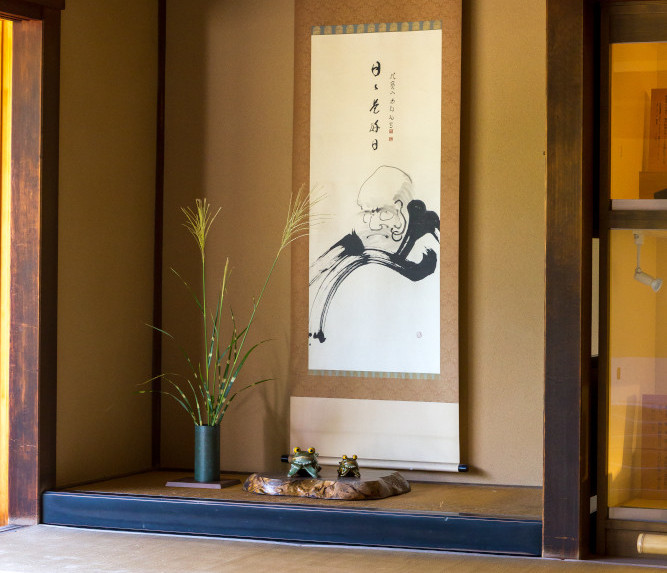
- Bokuseki (墨蹟, "traces of ink") is the calligraphy of Zen monks and is regarded in Japan as a category of its own within the art of writing. What is written is mostly short Zen sayings, single characters, or lines of poetry, often executed quickly, powerfully, and deliberately unpolished. Unlike shodō in general, the focus here is not on stylistic perfection but on the spiritual authority of the writer: many authors were not professional calligraphers but abbots and Zen masters. Bokuseki has a firm place in tea culture, where such a hanging scroll hangs in the tokonoma of the tea room and sets the tone of the gathering; inscriptions on tea utensils are also counted among them.Also: Bokuseki calligraphy, Zen calligraphy, Bokuseki, ink traces, ink trace calligraphyMore about Bokuseki in our topics
- Bunjin-hyōgu 文人表具
- Bunjin-hyōgu (文人表具), the "literati mounting," is a form of hanging scroll mounting adopted from China in which a single fabric or a single paper surrounds the work on all sides. It spread in Japan in the Edo period with the interest in the Chinese painting of the Ming and Qing dynasties. Its varieties include fukuro-hyōgu; if the fūtai are absent, one also speaks of maru-hyōgu. What distinguishes it from Yamato-hyōgu with its three graded fabrics is its unified, restrained effect, which often accompanies ink painting and calligraphy in the Chinese taste.Also: bunjin-hyogu, bunjin hyōgu, literati mounting, bunjin mountingMore about Bunjin-hyōgu in our topics
- Byōbu 屏風
- A byōbu is a Japanese folding screen made of several panels joined by paper hinges, their surfaces painted or decorated with calligraphy. The name literally means "wind wall," reflecting its original function: the screen divided a room and blocked drafts, while also serving as a support for painting. Common are pairs of two screens with six panels each, their composition to be read across both halves. Unlike the kakemono, a byōbu is freestanding and is not rolled up but folded together.Also: folding screen, byobu, byōbu, Japanese folding screen, room divider screenMore about Byōbu in our topics
C
- Chabana 茶花
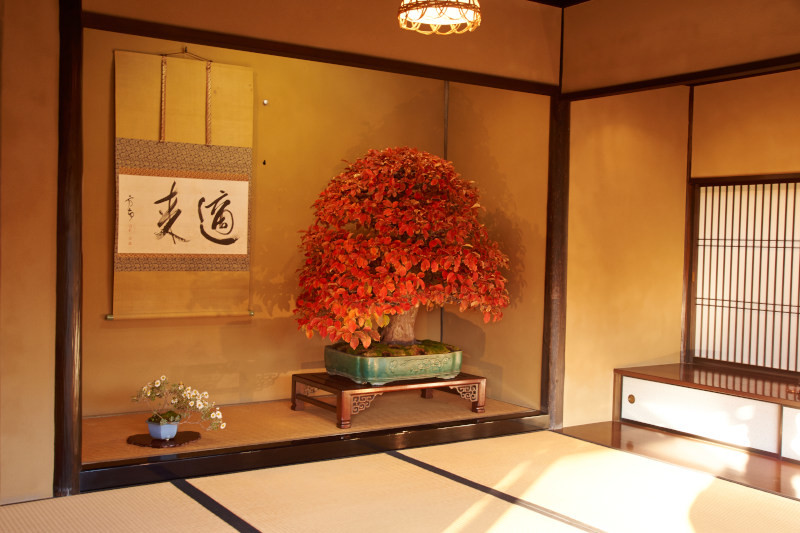
- Chabana (茶花, literally tea flower) is the floral arrangement of the Japanese tea ceremony and usually consists of very little: a camellia bud, a branch, a few grasses, placed as if they had grown that way. What is shown is whatever is blooming in that particular season, set in a hanaire made of ceramics, bamboo, or bronze, which stands in the tokonoma next to the hanging scroll. Compared to ikebana, which allows for more structure and visible composition, chabana deliberately recedes into the background: the flower should not appear arranged, but should merely bring a moment of the season into the tea room.Also: Chabana, tea flower, tea flowers, tea ceremony flowers, tea ceremony flower arrangement, chabana flower arrangementMore about Chabana in our topics
- Chadō 茶道
- Chadō (茶道, also read Sadō) is the "way of tea" – the Japanese tea ceremony, understood as a lifelong practice. The Dō is the same as in Shodō (calligraphy) or Budō (martial arts) and always signifies a path of practice rather than the mere acquisition of a skill: one learns the handling of bowl, whisk, and water over decades, under the guidance of a school. The four principles of harmony (Wa), respect (Kei), purity (Sei), and tranquility (Jaku) are considered the inner orientation. Chanoyu, by contrast, refers to the individual gathering at which tea is actually prepared and drunk.Also: Sadō, Chado, Sado, Way of Tea, Chanoyu, Japanese Tea CeremonyMore about Chadō in our topics
- Chaire 茶入
- A chaire is the small ceramic container used to store thick matcha for the tea ceremony, usually with a lid made of ivory or a substitute material and protected by a bag of silk brocade, the shifuku. Historically, chaire ranked among the most highly valued objects in tea culture altogether; individual pieces were traded like landed estates. It differs from the natsume in material and use: the lacquer container natsume belongs to thin tea, the ceramic container chaire to thick tea – an assignment that still holds true today.Also: Tea caddy, ceramic tea caddy, chaire, cha-ire
- Chaji 茶事
- A chaji (茶事) is the complete, formal form of the Japanese tea gathering: the host invites a small number of guests, serves them a kaiseki meal, offers sweets, and then prepares first thick koicha, then thin usucha. Such a proceeding traditionally lasts about four hours. Seven basic forms have been handed down, which differ chiefly according to the time of day, from the morning chaji to the evening chaji. The chaji differs from the chakai in length, meal, and the small, invited circle of guests; at a chakai usually only one sweet and one bowl of tea are served. Chanoyu is the overarching term for the gathering as such.Also: Cha-ji, chaji, formal tea gathering, full tea ceremony, formal tea ceremony
- Chakai 茶会
- A chakai (茶会) is the shorter, informal Japanese tea gathering at which guests are served a sweet and a bowl of tea, usually thin usucha, less often thick koicha. A meal is not included; accordingly, a chakai tends to last a scant hour rather than half a day. Particularly widespread is the ōyose-chakai, a large event at which groups of guests are led into the tea room one after another and for which no prior knowledge is required. The chakai differs from the several-hours-long chaji with its kaiseki meal in scope and formality, not in the utensils used.Also: Cha-kai, informal tea gathering, informal tea gathering, Ōyose-Chakai, Oyose-Chakai
- Chakin 茶巾
- A chakin (茶巾) is the small white cloth made of linen or hemp used in the Japanese tea ceremony to wipe out and dry the tea bowl. The host first warms the chawan with hot water, pours it into the wastewater vessel kensui, and then dries the bowl with the slightly damp chakin, folded into strips, before the matcha powder is added. A format of about thirty by fifteen centimeters is common; particularly prized is bleached hemp from Nara, called narazarashi. It differs from the silk fukusa in material and purpose: the chakin touches the bowl, the fukusa cleans the utensils.Also: chakin, chakin cloth, tea cloth, linen cloth used in the tea ceremony, cha-kin
- Chanoyu 茶の湯
- Chanoyu (茶の湯, literally "hot water for tea") is the Japanese tea ceremony as a concrete gathering: a host prepares matcha for invited guests following a set sequence and offers them the bowl. The term emphasizes the event itself – the room, the selected utensils, the sequence of movements, the hanging scroll in the tokonoma. A distinction is made between the shorter, informal gathering (Chakai) and the multi-hour, formal Chaji with a meal. Chadō, the way of tea, denotes the same practice but places the emphasis on lifelong practice. Both words continue to exist side by side today; Chanoyu is the older and more everyday term.Also: Cha-no-yu, tea ceremony, Japanese tea ceremony, Chadō, Way of TeaMore about Chanoyu in our topics
- Chasen 茶筅
- A chasen (茶筅) is the Japanese tea whisk made of bamboo, used to whisk matcha powder and hot water directly in the tea bowl into a fine-pored layer of foam. It is carved from a single piece of bamboo and, depending on the design, has roughly sixty to one hundred twenty fine, outward-curved tines. Its spatial requirements determine the geometry of the chawan: the whisk head must be able to move freely in a circular motion, which is why tea bowls are wide and flat on the inside. A chasen is a consumable item – after use it is simply rinsed with clear water, dried upright, and eventually replaced once the tines break.Also: tea whisk, bamboo tea whisk, matcha whisk, chasenMore about Chasen in our topics
- Chashaku 茶杓
- A chashaku (茶杓) is the narrow Japanese tea scoop made of bamboo, used to measure matcha powder out of the tea caddy and place it into the bowl. It is carved from a single piece of bamboo, bent slightly at the middle, and tapers into a flat, spoon-like blade; a node of the bamboo is often visible in the shaft. Together with chawan and chasen, it forms the essential basic equipment for preparing matcha – everything else is a matter of comfort. In the tea ceremony, chashaku are among the most personal implements: they are frequently given names, signed, and kept in their own case.Also: tea scoop, bamboo tea scoop, matcha scoop, chashakuMore about Chashaku in our topics
- Chawan 茶碗
- A chawan (茶碗) is the wide, handleless Japanese tea bowl in which matcha is whisked directly in the vessel with a bamboo whisk (chasen) and then drunk from the same bowl. It is thus both tool and drinking vessel at once, which explains its shape: a wide opening, a largely flat interior floor, an obliquely rising wall, and an unglazed foot ring (kōdai). Classic pieces usually measure eleven to thirteen centimeters in diameter. A yunomi, by contrast, is the taller, slimmer cup for infused leaf tea, and a guinomi is not a small chawan but a distinct sake vessel. Chawan are made in almost all ceramic traditions, from Raku ware to Hagi ware to Shino ware and Oribe ware.Also: tea bowl, chawan, chawan tea bowl, matcha bowl, matcha chawanMore about Chawan in our topics
- Chūmawashi 中廻し
- The chūmawashi (中廻し), also called chūberi (中縁), is the inner fabric border of a Japanese hanging scroll that surrounds the honshi and the ichimonji. It lies between the narrow ichimonji strips and the large fields of heaven and earth; its side strips are called hashira. In the three-tiered Yamato-hyōgu mounting it receives the second-finest fabric: quieter than the ichimonji, richer than the tenchi. The color and pattern of the chūmawashi shape the overall tone of a mounting in particular, because it surrounds the image directly.Also: chumawashi, chūberi, chuberi, inner borderMore about Chūmawashi in our topics
D
- Daikokuten 大黒天
- Daikokuten is the Japanese god of fortune associated with prosperity, agriculture, and commerce. His attribute is a magical mallet with which, according to legend, he spreads wealth wherever he strikes; he is usually depicted standing on rice bales and accompanied by rats. Originally he derives from a fearsome Indian deity and transformed in Japan into a friendly, stocky figure with a flat cap. He belongs to the Seven Lucky Gods, the Shichifukujin, and appears especially often together with Ebisu. Daikokuten was depicted on the first Japanese paper banknotes of 1885.Also: Daikoku, Daikoku-ten, Daikokusama, DaikokutenMore about Daikokuten in our topics
- Daruma 達磨
- Daruma is the Japanese name for Bodhidharma and, at the same time, the name of the folk good-luck figure that emerged from his iconography. The figure is round, has neither arms nor legs, and rights itself again after being knocked over – a symbol of perseverance, summed up in the proverb "Nanakorobi yaoki," fall down seven times, get up eight. It originated in talismans from the Daruma-dera in Takasaki; the first molds were made around 1770. Traditionally it is sold with two blank eyes: one is painted in when a resolution is made, the second as soon as the goal is achieved. Bodhidharma, by contrast, refers to the monk figure of tradition.Also: Daruma doll, Daruma-doll, Bodhidharma, Bodaidaruma, DarumaMore about Daruma in our topics
E
- E-Shino 絵志野
- E-Shino, "painted Shino," is the most common subtype of Shino ware from the Mino region. On the raw ceramic body, a motif is drawn with an iron-bearing painting pigment—known as Oniita—and then covered with the thick, milky-white feldspar glaze. During firing, the drawing shimmers as if through a mist and appears in tones ranging from brown to grayish-brown. The motifs remain mostly simple: grasses, branches, lattices, or abstract lines. E-Shino differs from Nezumi-Shino in its process—there, the surface is first covered entirely with an iron-bearing engobe and the pattern is then scratched back out, whereas here it is painted on directly.Also: Eshino, E Shino, Painted Shino, E-Shino ChawanMore about E-Shino in our topics
- Ebisu 恵比寿
- Ebisu is the Japanese god of fortune associated with commerce, prosperity, and fishermen, recognizable by his fishing rod and the large red sea bream. He is the only one of the Seven Lucky Gods, the Shichifukujin, of purely Japanese Shinto origin, and is especially popular among shopkeepers and business owners; an image of him is traditionally considered a fitting gift for a business opening. He frequently appears paired with Daikokuten, the two complementing each other: Ebisu represents a good catch and successful trade, while Daikokuten represents prosperity in the household. In rural regions of Japan, the two were long worshipped together on a small household altar.Also: Yebisu, Ebisu-sama, Ebisu, god of fortuneMore about Ebisu in our topics
- Echizen-yaki 越前焼
- Echizen-yaki is an unglazed Japanese stoneware from the area around Echizen in Fukui Prefecture and one of the six ancient kilns of Japan. Its beginnings are dated to the late 12th century; over the centuries, this region produced mainly large storage jars, pots, and grinding bowls, which were shipped along the coast of the Sea of Japan to wide parts of the country. The iron-rich clay fires dark, and as in Bizen or Tamba, it is solely the natural ash deposits from wood firing that shape the surface. The fact that Echizen is recognized as an independent ancient kiln tradition at all goes back to the research of ceramic historian Koyama Fujio around 1948.Also: Echizen-yaki, Echizen ware, Echizen ceramics, Echizen pottery, Echizen
- Edo-Zeit 江戸時代
- The Edo period (1603–1868), also called the Tokugawa period, is Japanese history's roughly 250-year era of peace during which the Tokugawa shogunate ruled from Edo, present-day Tokyo. From 1624, the sakoku policy largely sealed off the country, with Nagasaki remaining nearly the only trading port. It was precisely within this isolation that many traditions still alive today took shape: porcelain from Arita, Hagi ware and Kutani ware, the Ukiyo-e color woodblock print, decorative Rinpa painting, and the tea ceremony's broad social establishment. It follows the Azuchi-Momoyama period and ends in 1868 with the Meiji Restoration. As a dating designation, "Edo period" accordingly denotes a pre-industrial piece made before the opening of Japan.Also: Edo period, Tokugawa period, Edo era, Tokugawa eraMore about Edo-Zeit in our topics
- Emakimono 絵巻物
- An emakimono is a Japanese horizontal picture scroll: a horizontally oriented picture support made of paper or silk, which is unrolled and viewed section by section from right to left. Unlike the vertically formatted kakemono, which hangs on the wall, an emakimono lies on a surface while being viewed; the image unfolds while reading like a narrative and frequently combines painting with interspersed passages of text. The genre became famous through courtly literary illustrations of the Heian and Kamakura periods. Today it is found almost exclusively in museums and temple collections.Also: Emaki, handscroll, hand scroll, narrative handscroll, picture scrollMore about Emakimono in our topics
- Enso 円相
- The Enso (円相, "circular form") is a circle drawn with one or two unrestrained brushstrokes in Japanese Zen art, expressing enlightenment, emptiness (Shunyata), and the universe as a whole. It is created in a single, usually very rapid movement, typically in the cursive Sōsho style, and is not corrected; it is thus considered a direct reflection of the inner state of its creator. An open circle represents movement, development, and ongoing perfection, while a closed circle tends to represent completion and wholeness. The earliest known depiction is attributed to the Chinese Chan master Kyōzan (814–890).Also: Ensō, Enso circle, Zen circle, Enso symbol, Zen circle paintingMore about Enso in our topics
F
- Fuchin 風鎮
- Fuchin (風鎮) are paired Japanese decorative weights that hang from the two lower ends of a kakemono and keep it steady. The name literally means "wind calmer": they prevent the picture panel from swaying in drafts of air and, at the same time, gently stretch it lengthwise so that slight wrinkles smooth out more quickly. They are attached with a silk cord with a tassel over the jikusaki, the end pieces of the lower roller rod. Fuchin are made of ceramics, marble, onyx, rock crystal, wood, or metal and are traditionally purchased in pairs. A moderate weight is important, since fuchin that are too heavy place lasting strain on the mounting.Also: Fuchin, ornamental weights, kakemono weights, hanging scroll weights, scroll weights, fu-chinMore about Fuchin in our topics
- Fude 筆
- A fude (筆) is the Japanese writing and painting brush made of bundled animal hair set into a shaft of bamboo or wood, used for executing calligraphy and ink painting. Depending on the desired stroke, different hairs are used, such as goat, weasel, or horse: soft bundles produce full, absorbent strokes, while firmer ones yield a precise tip. Because a fude is worked into a round shape and can be guided in any direction, width, pressure, and ink density arise solely from the movement of the hand. The brush is therefore considered a direct extension of the calligrapher's hand and is counted among the "Four Treasures of the Study."Also: fude, calligraphy brush, Japanese calligraphy brush, ink brush, Japanese brushMore about Fude in our topics
- Fuji-San 富士山
- At 3,776 meters, Fuji-San is the highest mountain in Japan and at the same time the most frequently depicted motif in the history of Japanese art. As a sacred volcano, it has been considered the seat of deities for centuries; since the Edo period, Konohanasakuya-hime has been venerated as its principal deity. The most famous example of its pictorial tradition is Katsushika Hokusai's "Thirty-six Views of Mount Fuji," the first sketches of which were made in 1830. It is notable that artists regularly depicted the mountain larger than it actually appeared – the goal was not an accurate view but the ideal form. Here, the ending -san stands for mountain, not for the polite form of address.Also: Fuji, Mount Fuji, Fujisan, FujiyamaMore about Fuji-San in our topics
- Fukinsei 不均斉
- Fukinsei is the Japanese design principle of deliberate asymmetry: it avoids the mirror-image center and puts in its place shifted axes, odd numbers, and irregular forms. The philosopher Hisamatsu Shin'ichi (1889–1980) counts it among the fundamental features of Zen aesthetics in his book "Zen and the Fine Arts." Fukinsei becomes visible in the slightly uneven rim of a hand-formed tea bowl, in the composition of an ikebana, or in the arrangement of objects in the tokonoma. Unlike wabi-sabi, which describes a comprehensive attitude, fukinsei is a concrete compositional rule – it refers to deliberate imbalance, not arbitrariness.Also: asymmetry, irregularity, fukinsei principle, fukinsei, deliberate asymmetry, intentional asymmetryMore about Fukinsei in our topics
- Fukurokuju 福禄寿
- Fukurokuju is the Japanese god of fortune who embodies luck, prosperity, and a long life – the three characters of his name stand for exactly these three gifts. He is recognizable by a strikingly high, elongated forehead, which symbolizes great wisdom; in depictions he is often accompanied by a crane or a turtle. He belongs to the Seven Gods of Fortune and originates from the Chinese Taoist tradition. He is often barely distinguishable in images from Jurōjin, who likewise stands for longevity and bears the same high forehead; some traditions even consider the two to be the same figure.Also: Fukurokujin, Fukurokuju, god of fortune Fukurokuju, FukurokuMore about Fukurokuju in our topics
- Fukusa 袱紗
- A fukusa (袱紗) is the square silk cloth with which the host of a Japanese tea ceremony ritually purifies the utensils, above all the bamboo tea scoop chashaku and the tea container. The folding and handling of the cloth, called fukusa-sabaki, is its own precisely defined part of the procedure; the individual folds are traditionally interpreted symbolically. Color and handling depend on school and person: for men, dark purple cloths are customary, for women red or orange ones. Unlike the linen cloth chakin, which is used exclusively to wipe out the tea bowl, the fukusa is not used wet.Also: Fukusa cloth, silk fukusa, tsukai-fukusa, tea ceremony silk cloth
- Funpon 粉本
- Funpon (粉本) are the model collections of a Japanese painting workshop: tracings of older works, some exact copies, some quick sketches, mostly reduced in scale and passed down through generations. They constituted the actual capital of a workshop and were guarded accordingly. Workshop students rarely got to see originals by old masters; what they studied were their master's tracings, which served as a stylistic manual. The Kanō school developed this system most consistently – so consistently that later critics saw it as the reason for its ossification. Funpon differs from Mosha in that it denotes a body of holdings rather than an individual copy: Mosha refers to the act of copying itself, Funpon to the stock of models from which a workshop drew.Also: Fun-pon, funpon, pattern book, workshop patterns, stencil patterns, copybook, pounce patternMore about Funpon in our topics
- Furuta Oribe 古田織部
- Furuta Oribe (古田織部, 1544–1615), actually Furuta Shigenari, was a Japanese warrior and tea master, after whom the green Oribe ware is named. He served Oda Nobunaga and Toyotomi Hideyoshi, became a disciple of Sen no Rikyū, and after the latter's death in 1591 was regarded as Japan's leading tea master; he taught the Shōgun Tokugawa Hidetada and founded his own tea school, the Oribe-ryū. Where Rikyū sought reduction, Oribe favored movement: dented rims, obliquely drawn walls, bold copper green. How directly he actually guided the potters in Mino is disputed in scholarship – what is certain above all is that his taste shaped the style.Also: Oribe, Furuta Shigenari, Furuta Oribe tea master, Furuta Oribe-no-shinMore about Furuta Oribe in our topics
- Fusuma 襖
- Fusuma are the opaque sliding doors of the Japanese house: a light wooden frame covered on both sides with paper or fabric, bordered by a frame strip, and fitted with a recessed finger pull. They divide the interior space and can be removed so that several rooms become one. Unlike shōji, whose wooden lattice, covered on one side only, admits daylight in muted form, fusuma are opaque – and thus a picture surface: alongside kakemono and byōbu, their surfaces rank among the classic picture supports of Japanese painting, and in temples and castles they often bear a landscape running continuously across several doors.Also: Fusuma door, Fusuma-shōji, Fusuma sliding door, sliding panel, painted sliding door, fusuma panelMore about Fusuma in our topics
- Fūtai 風帯
- Fūtai (風帯, literally "wind bands") are two narrow fabric bands that, in many Japanese hanging scrolls, hang down from the upper rod over the heaven field of the mounting. They are sewn to the hassō, are as long as the heaven field, and divide it into three equal sections. In formal mountings they are made of the same fabric as the ichimonji and hang loose; in freer forms they are merely pasted on (oshi-fūtai) or omitted altogether. At their lower ends there are often small thread tassels, the tsuyu ("dew"). They are to be distinguished from fuchin, the weights on the lower rod: fūtai are a fixed part of the mounting.Also: futai, fuutai, wind bands, fūtai bandsMore about Fūtai in our topics
G
- Gō 号
- A gō is a Japanese art name that painters, calligraphers, and potters use in place of their civil name and with which they sign their works. It is often adopted upon completing an apprenticeship, occasionally bestowed by the teacher, and many artists carry several over the course of their lives – when changing workshops, when taking on a family name, or after a caesura in their own body of work. Two signatures that seem to have nothing to do with each other may therefore come from the same hand. For research this means: a gō is a search term, not a proof of identity. In pottery dynasties, there is additionally the name of the lineage passed down through generations.Also: Go, gō, artist name, art name, gagō, pseudonym, studio nameMore about Gō in our topics
- Gohonte 御本手
- Gohonte (御本手) refers to a pattern of fine pinkish to light spots on a gray-beige ground, as it appears above all on tea bowls. It is not painted on but arises during firing from the interplay of the iron-rich clay with the pale ash glaze lying over it, emerging from the body itself. The name goes back to the Gohon, the order templates with which Japanese tea masters commissioned bowls from Korean kilns from the late 16th century onward. Today Gohonte is especially closely associated with Hagi ware, where, alongside Shira-Hagi and Ido-Hagi, it is considered a distinct color variant.Also: Gohon, Gohon-te, Gohon chawanMore about Gohonte in our topics
- Goma 胡麻
- Goma, Japanese for "sesame," refers to the grainy ash speckles on unglazed Bizen ware that look as though someone had scattered sesame seeds over the surface. They form when fly ash from the days-long wood firing settles on the ceramic body and melts there into glass at individual points, without merging into a continuous layer. The grains sit densely on the side facing the fire, decreasing toward the back. Goma is thus a particular manifestation of shizen-yū, the natural ash deposit; when the ash flows together into a clear, greenish shimmering pool, it is instead called bidoro.Also: goma, goma ash, sesame seed ash, ash glaze specklingMore about Goma in our topics
- Gosu 呉須
- Gosu is the cobalt-bearing painting agent used in Japanese underglaze painting: a mineral pigment applied to the pre-fired biscuit before the glaze firing, and which withstands the high firing temperature unharmed. Natural gosu is not pure cobalt oxide but an ore containing traces of manganese and iron; these give the historical blue its grayish tone, often tending toward gray-blue. For a long time the material was imported from China, later also mined in Japan; in addition came synthetically produced cobalt, whose blue appears clearer and cooler. Gosu is thus the material, Sometsuke the decorative technique carried out with it.Also: gosu, gosu blue, cobalt blue pigment, cobalt pigment, asbolite, asbolaneMore about Gosu in our topics
- Guinomi ぐい呑
- A guinomi (ぐい呑) is the Japanese sake cup for a hearty draft – somewhat larger and deeper than the small ochoko, usually made of ceramics and rarely of glass. The name alludes to the fact that sake is drunk in a few draughts; correspondingly, such a cup holds only a few sips. It is filled from the tokkuri, and in Japan it is traditionally not poured for oneself, but for the person across from you. A guinomi is not a chawan in miniature format, but built for drinking rather than for preparation: it lacks the flat base needed for the tea whisk. Because a potter's handwriting shows itself in such a small space, guinomi are popular among collectors.Also: sake cup, Japanese sake cup, Gui-nomi, guinomiMore about Guinomi in our topics
- Gyōsho 行書
- Gyōsho (行書) is the semi-cursive script of Japanese calligraphy, in which individual strokes of a character are joined together without the basic form being lost. It arises from the swift, unbroken movement of the brush and appears more flowing and personal than the block script Kaisho, yet remains considerably more legible than the highly abbreviated cursive script Sōsho. Gyōsho thus occupies an intermediate position among the five classical styles and was historically the common script used for letters and notes. In training, it usually follows only after Kaisho has been securely mastered.Also: Gyosho, Gyōsho-tai, semi-cursive script, running script, semi-cursive styleMore about Gyōsho in our topics
H
- Hagi no Nanabake 萩の七化け
- Hagi no Nanabake (萩の七化け), "the seven transformations of Hagi," refers to the slow color change that a piece of Hagi ware undergoes through use. Because the glaze and the body are porous and carry a fine network of cracks (kannyū), tea or sake penetrates the clay over the years and gradually tints the initially pale, rosy-shimmering surface amber to brownish. The number seven is not meant literally but expresses that such a piece takes on a different face several times over the years. Connoisseurs see this not as wear but as genuine maturation - which is why Hagi ware is cleaned with clear water only, since dish soap, too, would soak into the clay.Also: Nanabake, Seven Transformations, Seven Transformations of Hagi, Hagi no NanabakeMore about Hagi no Nanabake in our topics
- Hagi-yaki 萩焼
- Hagi ware is Japanese stoneware ceramics from the city of Hagi in Yamaguchi Prefecture, founded in 1604 by Korean potters under the feudal lord Mōri Terumoto. It is characterized by a pale, translucent glaze with a fine network of cracks (Kannyū), through which tea or sake seep into the porous clay body over the years, gradually darkening it – a maturing process called Hagi no Nanabake, the "seven transformations." Many chawan also feature a notch in the foot ring, called Kirikodai. Alongside Raku ware and Karatsu ware, Hagi ware is considered one of the three most highly esteemed traditions in the tea ceremony; unlike Raku, however, it is thrown on the wheel.Also: Hagi-yaki, Hagi ware, Shira-Hagi, HagiMore about Hagi-yaki in our topics
- Hakogaki 箱書き
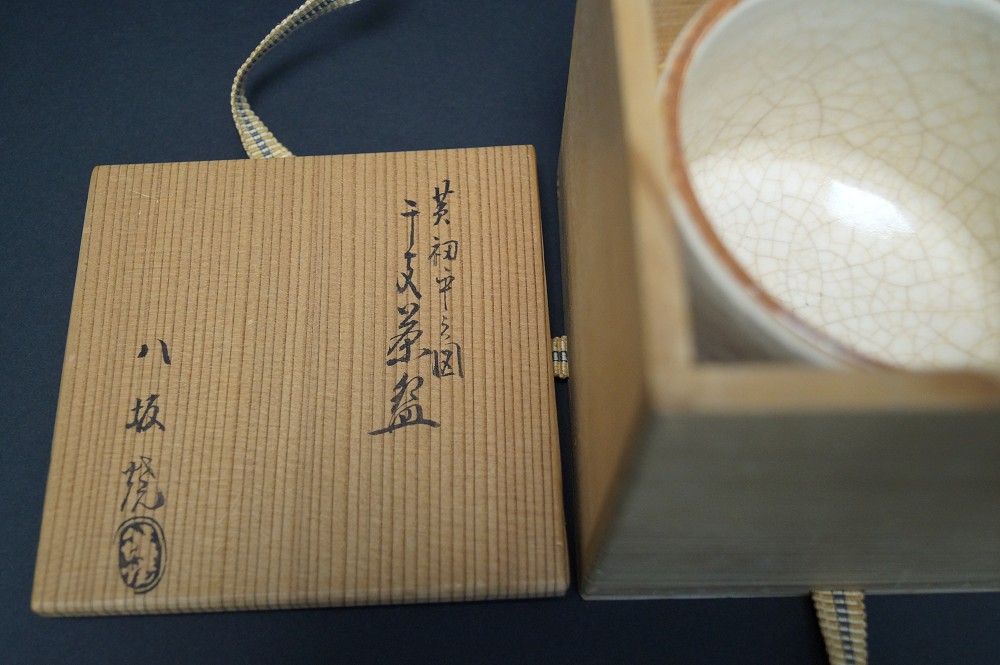
- Hakogaki is the brush inscription on the wooden box in which a Japanese work of art is kept. It follows a remarkably stable order: the lid or the front bears the designation of the object, next to it the kiln or the style, and on another surface the artist's name, concluded by a seal or a handwritten kakihan. It is written almost always in sōsho, the highly simplified cursive script, which makes deciphering it laborious even for those versed in Japanese. If the inscription originates from the artist himself or his studio, it is called a tomobako. A box inscribed by a third party, such as a tea master, likewise bears a hakogaki – but it attests to something different.Also: Hako-gaki, box inscription, box signature, tomobako inscription, lid inscriptionMore about Hakogaki in our topics
- Hanko 判子
- A hanko is the seal stamp itself, a small stick of stone, wood, horn, or ivory, with a name cut in mirror-image on its face. In Japan it replaces the signature in daily life; in art it authenticates paintings, calligraphy, and the inscriptions on wooden boxes. Its impression is created with shuniku, red cinnabar paste, and sits dense and minimally raised with irregular edges – a merely printed seal, by contrast, appears flat and uniform. To be distinguished from the hanko are the rakkan, that is, the signature and impression as a whole, and the kakihan, which is written rather than stamped. Many artists use several hanko side by side.Also: Inkan, Hanko seal, Japanese seal, Japanese name seal, Seal stamp, Name stampMore about Hanko in our topics
- Hannya Shingyō 般若心経
- The Hannya Shingyō (般若心経) is the Japanese name for the Heart Sutra, a central text of Mahayana and especially Zen Buddhism, which condenses the teaching of emptiness (Shunyata) into 262 characters. It probably originated between the 1st and 3rd century in northern India and is structured as a dialogue between the Bodhisattva Avalokiteśvara and the monk Śāriputra; "Hannya" renders the Sanskrit word Prajñā, wisdom. Due to its brevity and philosophical depth, the Heart Sutra is the most frequently copied text in Japanese calligraphy and often adorns domestic meditation rooms as a Kakemono.Also: Heart Sutra, Heart Sūtra, Hannya Shingyo, Hannya Shingyō, Prajnaparamita Sutra, Prajñāpāramitā Sutra, Prajnaparamita Hridaya Sutra, Hannya-ShingyoMore about Hannya Shingyō in our topics
- Hasami-yaki 波佐見焼
- Hasami ware is Japanese porcelain from the town of Hasami in Nagasaki Prefecture, whose kilns, according to tradition, trace back to 1599 and Korean potters in the service of the Ōmura domain; excavation findings suggest a somewhat later period of operation. Unlike the court-influenced neighboring traditions, Hasami was oriented from the outset toward everyday tableware produced in large quantities: toward the plain kurawanka bowls for common people and toward the compra bottles in which soy sauce and sake were exported via Nagasaki. In the late Edo period, Hasami was the largest producer of blue-and-white porcelain in Japan. Because the ware was long marketed through Arita, it has only appeared under its own name since the 2000s.Also: Hasami-yaki, Hasami porcelain, Hasami ware, Hasami
- Hashira 柱
- Hashira (柱, "pillar") refers to the two vertical brocade strips that run to the left and right of the Honshi in the mounting of a Japanese hanging scroll. They belong to the Chūmawashi, the inner border, and delimit the work on the sides, while the Ichimonji frame it horizontally at the top and bottom. For the Hashira, a more subdued fabric is usually chosen than for the Ichimonji, so that the border does not overpower the work; their width also shapes the effect of the entire mounting. How wide they turn out and what fabric they are made of depends on the chosen mounting style.Also: Hashira strip, hashira border, side border, side strip, chūmawashi-hashiraMore about Hashira in our topics
- Hassō 八双
- The Hassō (八双) is the narrow wooden strip at the upper end of a Japanese hanging scroll, its cross-section worked into a half-moon shape; the term Hyōmoku is also commonly used for it. The hanging cord Kakehimo is attached to it by way of two metal rings (Kan), and it is around the Hassō that the picture panel comes to rest last when rolling up the scroll. Unlike the lower round rod Jiku, which pulls the kakemono smooth through its weight, the Hassō is deliberately kept light: it closes off the top of the scroll and carries it without weighing it down. Together, Hassō and Jiku form the two crossbars between which the entire mounting is stretched.Also: Hassō, Hasso, Hachisō, hyōmoku, top roller, top rodMore about Hassō in our topics
- Heian-Zeit 平安時代
- The Heian period (794–1185) is the era during which the imperial court ruled from Heian-kyō, present-day Kyōto; Emperor Kanmu moved the capital there in 794. Politically, the Fujiwara regents controlled the court, while culturally, after the end of the missions to China, a distinctly native court culture emerged. Within it developed the syllabic script Kana and, with it, court literature – Murasaki Shikibu's Genji Monogatari is its best-known work – as well as the colorful pictorial tradition Yamato-e with its Emakimono picture scrolls. The era follows the Nara period and ends in 1185 with the victory of the Minamoto over the Taira.Also: Heian period, Heian era, Heian Period
- Heisei-Zeit 平成時代
- The Heisei period (1989–2019) is the era under Emperor Akihito that began at the height of the "bubble economy" and, after its collapse, led into the economically stagnant "lost decades." It was also marked by severe disasters, the Hanshin earthquake of 1995 and the Tōhoku earthquake with tsunami and Fukushima in 2011. It was precisely amid this uncertainty that handcrafted arts and crafts gained renewed appreciation as a counterpoint to short-lived mass-produced goods, while wabi-sabi and kintsugi became internationally known. It follows the Shōwa period and ended in 2019 with Akihito's abdication; since then, the Reiwa period has been in effect. Heisei-dated pieces are thus contemporary works.Also: Heisei period, Heisei, Heisei eraMore about Heisei-Zeit in our topics
- Hidasuki 緋襷
- Hidasuki, literally "fire cords," are the orange-red lines on unglazed Bizen ware that form when a vessel is wrapped with rice straw before firing. Where the straw lay against the clay, its ash components react with the iron in the shard, leaving sharply drawn traces on a light-colored ground. Originally, the wrapping was a practical trick to keep stacked vessels from fusing together in the kiln; only later was the pattern deliberately sought after. Unlike Goma or Shizen-yū, Hidasuki does not rely on airborne ash deposits but on direct contact - the line follows precisely the course of the straw.Also: Hi-dasuki, fire cord marks, straw markings, rice straw markings, Hidasuki Bizen, Hidasuki-Bizen wareMore about Hidasuki in our topics
- Hira-jawan 平茶碗
- A hira-jawan (平茶碗) is the flat, very wide-open Japanese tea bowl used for the height of summer. Its large surface lets the matcha cool more quickly, and the eye is drawn to a broad green expanse in which the light is reflected – an image that conveys coolness before the first sip is taken. It is the summer counterpart to the tall, cylindrical tsutsu-jawan, which retains warmth in winter. Between these two extremes stands the ordinary round bowl, which serves throughout the year. The seasonal change of the bowl is one of the most vivid features of Japanese tea culture.Also: Hirajawan, Hira-chawan, flat tea bowl, summer tea bowlMore about Hira-jawan in our topics
- Hirado-yaki 平戸焼
- Hirado ware is the older name for the porcelain of the Mikawachi kilns in present-day Sasebo, Nagasaki Prefecture, named after the Hirado domain, whose ruling Matsura family maintained the manufactory from the 17th century onward. It refers to the same ware as Mikawachi ware: a very white, fine-grained body made of porcelain stone from Hariojima Island and from Amakusa, restrained underglaze painting in cobalt blue, and elaborate openwork and relief work. Under this name the ware also became known outside Japan in the 19th century. It differs from neighboring Arita ware in its courtly origin and its avoidance of dense, all-over color decoration.Also: Hirado-yaki, Hirado porcelain, Hirado ware, Hirado
- Hishaku 柄杓
- A hishaku (柄杓) is the bamboo ladle of the Japanese tea ceremony, used to scoop hot water from the iron kettle Kama into the tea bowl and to replenish cold water from the fresh water container Mizusashi. It consists of a hollowed-out piece of bamboo forming the scoop and a thin handle with a bamboo node at its center. There are distinct versions for the two halves of the year: for the portable brazier Furo used in the warm months, the handle is longer and the cut at the end is angled downward; for the sunken hearth Ro used in the cold months, it is shorter and the scoop is larger. The way the ladle is set down also follows fixed forms.Also: bamboo ladle, water ladle, dipper, hishaku, hi-shaku
- Hiyose ひよせ
- Hiyose is the iron-rich clay from which unglazed Bizen ware is made. It is extracted in the area around Imbe, the historical center of the tradition, mainly from deeper layers beneath the rice paddies – mountain clay that flowing water has carried there and deposited over time. It is fine-grained and highly plastic, while at the same time not very refractory, which is a factor in the slow, multi-day firing of the Bizen kilns. Before being worked, it is left outdoors for months to years, then levigated and mixed. Its use in Bizen is usually dated to the end of the Muromachi period. It is only its high iron content that gives rise, in the glaze-free firing, to the colors and effects for which Bizen is known.Also: Hiyose clay, Bizen clay, Hiyose loamMore about Hiyose in our topics
- Honshi 本紙
- The honshi (本紙) is the actual artwork within a Japanese hanging scroll – the painting or calligraphy executed on paper or silk that sits at the center of the mounting. Everything around it does not belong to it: the brocade panels of the border, the narrow upper rail, the lower roller rod. During mounting, the honshi is backed by the hyōgu-shi with several extremely thin layers of washi, traditionally using wheat starch paste. Anyone assessing the condition of a kakemono examines both separately: a border coming loose is a problem of the mounting, while a tear running across the honshi affects the work itself.Also: Hon-shi, honshi, picture area, picture support, center panel of the hanging scrollMore about Honshi in our topics
- Hoshino-yaki 星野焼
- Hoshino-yaki is a Japanese ceramic tradition from the village of Hoshino, today part of the city of Yame in Fukuoka Prefecture, which was operated during the Edo period as the domain kiln of the Arima house of Kurume. Because the area is a tea-growing region, the kiln produced mainly tea storage jars and tea utensils. The local clay contains a high iron content and is considered difficult to work with; famous is the rare Yūhi-yaki, whose walls glow golden as soon as tea or sake is poured in. The last kiln went out of use in 1894. It was not until 1969 that Yamamoto Genta revived the tradition after roughly eighty years; since then, further workshops have been established in the village.Also: Hoshino-yaki, Hoshino ware, Hoshino
- Hotei 布袋
- Hotei is the round-bellied, ever-smiling Japanese god of fortune who represents contentment and abundance and is often called the "Laughing Buddha" in the West. His attribute is a large cloth sack in which, according to legend, he carries gifts for children; he is depicted with a bared belly, an open laugh, and often a fan. His roots lie in Chinese Buddhism, where he is traced back to a wandering monk figure. Hotei is one of the Seven Lucky Gods, the Shichifukujin, and alongside Jurōjin he is the one most frequently depicted alone in painting - without the rest of the group.Also: Laughing Buddha, Budai, Hotei-son, Hotei, god of fortune HoteiMore about Hotei in our topics
- Hyōgu 表具
- Hyōgu (表具) is the Japanese art of mounting – the craft that turns painting and calligraphy on paper or silk into hanging scrolls, handscrolls, folding screens, sliding doors, or albums in order to preserve and display them. The term hyōsō (表装) is used synonymously. For a kakemono, the mounter, the hyōgu-shi, backs the work with several layers of washi and wheat starch paste and sets it in matched fabrics. Unlike a Western picture frame, the mounting is firmly joined to the sheet and is rolled with it; because the paste remains water-soluble, it can nevertheless be removed and renewed after generations.Also: hyogu, hyōsō, hyoso, mounting, scroll mountingMore about Hyōgu in our topics
- Hyōgu-shi 表具師
- A Hyōgu-shi (表具師) is a Japanese mounter – the craftsman who mounts paintings and calligraphy into hanging scrolls, standing screens, or sliding doors. His work is called Hyōgu: he backs the Honshi with several paper-thin layers of Washi and wheat starch paste, selects the brocade strips of the mounting to match the motif, and fits the batten, roller rod, end caps, and cord. This also includes remounting, in which the work is completely detached from its old backing layers, cleaned, and rebuilt anew. In Japan, such an intervention is traditionally planned at intervals of about one hundred to one hundred fifty years.Also: hyōgu-shi, hyogu-shi, hyōgushi, hyogushi, scroll mounter, hanging scroll mounter, mounterMore about Hyōgu-shi in our topics
I
- Ichimonji 一文字
- Ichimonji (一文字) refers to the narrow horizontal bands of fine brocade positioned directly above and below the honshi in the mounting of a Japanese hanging scroll. The name derives from the character 一, meaning "one" – a single horizontal stroke, whose shape the bands echo. Traditionally, the most precious fabric of the entire mounting is used for these bands, often interwoven with gold threads; the upper band is usually wider than the lower one. The Ichimonji frame the work and mediate between it and the quieter brocade panels surrounding it – a detail from which the care taken in a mounting can readily be read.Also: Ichimonji, Ichimonji-jō, Ichimonji-ge, ichimonji border, brocade stripMore about Ichimonji in our topics
- Iga-yaki 伊賀焼
- Iga ware is a Japanese stoneware from the city of Iga in Mie Prefecture, based on the same heat-resistant clay deposits of the ancient Lake Biwa as neighboring Shigaraki. It became a distinct tradition during the Momoyama and early Edo periods, when the feudal lords Tsutsui Sadatsugu and later Tōdō Takatora had tea utensils fired there specifically: water jars and flower vases of a markedly rugged, often warped form. Characteristic features are the green glass flow of melted fly ash (Bidoro), black fire marks, and applied, ear-shaped handles. It is precisely on this point that tradition distinguishes the two kilns: "Iga has ears, Shigaraki has none." Since the middle Edo period, heat-resistant cooking pots have dominated production.Also: Iga ware, Iga-yaki, Ko-Iga, Iga
- Ikebana 生け花
- Ikebana is the Japanese art of flower arranging, combining branches, blossoms, and vessel into a deliberately composed, usually asymmetrical arrangement. Unlike the Western bouquet, what matters is not fullness but line: stems, the spaces between them, and the direction in which a branch points are all part of the design. The choice of vessel follows the style – flat, wide bowls (Suiban) with a kenzan for the Moribana style, tall vases for upright arrangements. To be distinguished from Ikebana is Chabana, the tea flower: it often makes do with a single branch and follows the guiding principle of arranging the flower the way it stands in the field.Also: Kadō, Kado, way of flowers, Japanese flower arrangement, art of flower arranging
- Imari-yaki 伊万里焼
- Imari ware refers to Japanese porcelain from the region around Arita in Saga Prefecture, which was shipped via the nearby port of Imari – the name thus denotes the trade route, not the place of manufacture. From 1659, this ware reached Europe in large quantities via the Dutch East India Company, after Chinese porcelain exports had collapsed during the Ming-to-Qing dynastic transition. In Europe, this simultaneously became a decorative style name: dense painting in underglaze blue with overglaze red and gold, called Kinrande in Japan. The historical export ware is called Ko-Imari. In Japan today, porcelain from the city of Imari itself is regarded primarily as Imari ware, while ware from Arita is regarded as Arita ware.Also: Imariyaki, Ko Imari, Imari ware, Imari ceramics, Imari pottery, Imari decor, Imari-yakiMore about Imari-yaki in our topics
- Ishigaki-yaki 石垣焼
- Ishigaki ware is a young Japanese ceramic from the island of Ishigaki in Okinawa Prefecture, whose kiln was opened in 1999 by Kaneko Haruhiko. Its distinguishing feature is a specially developed technique in which clear glass is fused with a Yuteki-Tenmoku glaze: over the black, silver-speckled glaze base lies a layer of glass that recreates the translucent blue of the surrounding reefs and is therefore called Ishigaki blue. Unlike the old traditions of the mainland, Ishigaki ware does not draw on a historical kiln but on a modern technique; pieces of it are held, among other places, in the British Museum.Also: Ishigaki-yaki, Ishigaki ware, Ishigaki pottery, Ishigaki
- Iwami-yaki 石見焼
- Iwami ware is a Japanese stoneware from the area around Gōtsu and Hamada in the western part of Shimane Prefecture, the former Iwami Province, whose beginnings date back to the mid-18th century. It is distinctly utilitarian ware: famous are the Handō, large water jars that were fired in quantity during the Meiji period and distributed throughout the country via the Kitamae shipping routes. The local clay tolerates high firing temperatures and yields a dense body resistant to acid and salt. The glaze most commonly used is the deep reddish-brown Kimachi or a bluish translucent glaze made from Yunotsu stone. Large pieces are built up using the coiling technique.Also: Iwami ware, Iwami yaki, Gōtsu-yaki, Iwami
- Izushi-yaki 出石焼
- Izushi ware is a Japanese porcelain from the Izushi district of Toyooka in Hyōgo Prefecture. Its basis is the porcelain stone discovered at Kakitani in 1789, which is exceptionally low in iron; in 1793, with the help of a specialist from Hizen, the first porcelain firing succeeded, after which the town's older kiln was converted to porcelain. The result is an almost pure white body, which is usually left unpainted; the decoration is provided by the working of the material itself, that is, relief carving and openwork carving. This is precisely the difference from Arita, where underglaze blue and polychrome painting carry the effect.Also: Izushi porcelain, Izushi ware, Izushi-yaki, Izushi-Hakuji, Izushi
J
- Jiki 磁器
- Jiki is the Japanese term for porcelain: a body made from porcelain stone or kaolin, densely sintered at approximately 1,250 to 1,400 degrees, that is white and impermeable to water, translucent in thin areas, and produces a clear ring when struck. In Japan, jiki has only been produced since the early 17th century, first in Arita; Imari, Kutani, Hirado, and Nabeshima belong to this group. It differs from tōki, the porous, colored stoneware, in raw material, firing temperature, and density – and in use, in that it does not absorb liquid. Together, both form the field of yakimono.Also: Jiki, Jiki ware, Japanese porcelain, porcelain, hard-paste porcelainMore about Jiki in our topics
- Jiku 軸
- The jiku (軸) is the round rod at the lower end of a Japanese hanging scroll, around which the picture panel is rolled up; its fuller name is jikugi (軸木). Its weight pulls the kakemono smooth, so that it hangs quietly against the wall. The character 軸 means axis or shaft, which is why it also appears in the word kakejiku, the "hanging axis." To be distinguished from the jiku are the jikusaki (軸先), its visible end pieces made of bone, wood, ceramics, or plastic: the rod is the supporting component, while the jikusaki are the decorative fittings at its two ends.Also: Jikugi, roller rod, bottom roller, wooden rollerMore about Jiku in our topics
- Jikusaki 軸先
- Jikusaki (軸先) are the visible end pieces of the lower roller rod of a Japanese hanging scroll – the two knobs that protrude to the left and right of the picture panel. They are made of bone, turned wood, ceramics, lacquer, or plastic, and their material is a useful indicator of the effort put into a mounting: bone, wood, and ceramics suggest careful work, while glossy plastic tends to indicate a simple or later one. They are to be distinguished from the jiku itself, the roller rod at whose ends they sit. The cords of the fuchin are also draped over the jikusaki.Also: jiku-saki, jikusaki, roller end knobs, scroll roller ends, hanging scroll end knobs, hanging scroll roller endsMore about Jikusaki in our topics
- Jōmon-Zeit 縄文時代
- The Jōmon period is the prehistoric era of Japan, usually dated to approximately 14,000 to 300 BCE; the figures vary depending on the archaeological evidence and the state of research. It takes its name from the cord-marked patterns of its vessels – Jōmon means "cord pattern" – which were rolled into the damp clay using twisted cords. This ceramics, fired in open fires at comparatively low temperatures, is considered among the oldest in the world. The Jōmon period is followed by the Yayoi period, with wet rice cultivation and vessels of markedly simpler form; thus Jōmon stands at the beginning of Japanese ceramics history.Also: Jomon period, Jōmon period, Jomon culture, Jōmon culture, Jomon era, Jomon, JōmonMore about Jōmon-Zeit in our topics
- Jurōjin 寿老人
- Jurōjin is the Japanese god of longevity, depicted as an old scholar with a high forehead, a long white beard, and a staff. In paintings he is almost always accompanied by a deer or a crane – both animals that symbolize longevity in Japan. He belongs to the Seven Lucky Gods, the Shichifukujin, and originates from Chinese tradition. Images of Jurōjin are a common gift for milestone birthdays. He is not always clearly distinguishable in depictions from Fukurokuju, who likewise stands for a long life and bears the same conspicuously high forehead.Also: Jurojin, Jurōjin, Juroujin, God of Longevity, God of Long LifeMore about Jurōjin in our topics
K
- Kachō-ga 花鳥画
- Kachō-ga (花鳥画, "flower-and-bird picture") is the Japanese genre of flower and bird painting, in which plants, birds, and insects usually appear within a sparingly indicated fragment of nature. The genre originated in Chinese painting and was cultivated in Japan by nearly all schools; Araki Kanpō (1831–1915) is considered one of its most important representatives of the Meiji period. Kachō-ga combines precise observation of nature with a clear seasonal reference, which is why such hanging scrolls are traditionally hung to match the season. Unlike the landscape painting genre Sansui, which draws the gaze into the distance, Kachō-ga works at close range and thrives on the single, precisely observed detail.Also: Kachoga, Kacho-ga, Kachōga, bird-and-flower painting, flower-and-bird painting, kachō-eMore about Kachō-ga in our topics
- Kaisho 楷書
- Kaisho (楷書) is the block script of Japanese calligraphy: each stroke is set down individually, cleanly separated, and executed in a prescribed order, so that the characters remain clear and easily legible. It is regarded as the foundation of calligraphy training, because the structure and proportion of a character are most clearly revealed in it, and it also serves as the model for printed typefaces. Among the five classical styles, Kaisho stands between the older clerical script Reisho and the connected forms: compared to the semi-cursive Gyōsho and the highly abbreviated Sōsho, it remains strict and composed. Sutra copies are frequently executed in Kaisho.Also: Kaisho-tai, kaisho style, block style, standard scriptMore about Kaisho in our topics
- Kakehimo 掛緒
- The kakehimo (掛緒) is the hanging cord of a Japanese hanging scroll. It is attached via two metal rings to the narrow upper roller and is placed over the wall hook when hanging the scroll – while the scroll is still fully rolled up, since only afterward is the scroll allowed to slowly unroll downward. When taking the scroll down, the order is reversed: first roll it up, then take it off the hook, then wind the cord neatly around the scroll and secure it with the binding tape. Tight enough that nothing comes undone, but not so tight that the tape presses into the silk.Also: kake-himo, hanging cord, hanging scroll cord, scroll cordMore about Kakehimo in our topics
- Kakejiku 掛軸
- A kakejiku (掛軸) is a Japanese hanging scroll, that is, a painting or work of calligraphy executed on paper or silk, mounted into a fabric border and rolled up around a lower roller rod. Literally, the term means "hanging scroll" or "hanging axis," thereby emphasizing precisely the movable construction of rods, brocade panels, and hanging cord. In present-day usage, kakejiku and kakemono (掛物) refer largely to the same thing. Kakemono is the more general term for a hanging work, kakejiku the technically narrower term for the mounted scroll; in practice, the two are mostly used synonymously.Also: Kakemono, Kake-jiku, Japanese hanging scroll, Kakejiku hanging scrollMore about Kakejiku in our topics
- Kakemono 掛物
- A kakemono (掛物) is a Japanese hanging scroll: a painting or calligraphy on paper or silk, surrounded by a mounting of silk brocade, closed at the top by a narrow slat and at the bottom by a heavier round rod, around which the panel can be rolled up. Unlike a framed picture, it does not hang permanently on the wall but is brought out for an occasion or a season – traditionally in the tokonoma – and afterward kept again in its wooden box. The term literally means "hanging thing" and is used today largely synonymously with kakejiku (掛軸), which more strongly emphasizes the rollable form with rods.Also: Kakejiku, hanging scroll, kakemono, Japanese hanging scroll, scroll paintingMore about Kakemono in our topics
- Kakiemon 柿右衛門
- Kakiemon is a decorative style of Japanese porcelain from Arita in Saga Prefecture, named after the Sakaida Kakiemon family of potters, who developed it in the second half of the 17th century. Its foundation is a type of body called nigoshide, a warm milky white reminiscent of rice-washing water. Over this sits an overglaze enamel painting in warm shades of red and orange, yellow, green, and blue, arranged asymmetrically and deliberately leaving large areas free; underglaze blue is generally absent, and the rim often carries an iron-brown band. Unlike the densely painted Imari decoration, Kakiemon draws its character from the white space left open. In 1971 the nigoshide technique was recognized as an Important Intangible Cultural Property of Japan.Also: Kakiemon ware, Kakiemon-yaki, Kakiemon style, Kakiemon porcelain, Nigoshide, nigoshideMore about Kakiemon in our topics
- Kakihan 花押
- A kakihan is a handwritten monogram developed from its bearer's name and written with the brush in a single stroke. It is found primarily in the hakogaki, the inscription on a wooden box, usually below or beside the artist's name, where it takes the place of a seal. Unlike a hanko, it requires no tool: it is drawn, not stamped, and therefore turns out slightly different with each writing. Historically, the form goes back to medieval documents, where it replaced the signature. For attributing a piece, a kakihan is one clue among several, not proof of authenticity.Also: Kaō, brush monogram, cipher signature, painted monogramMore about Kakihan in our topics
- Kama 釜
- A kama (釜) is the cast-iron water kettle of the Japanese tea ceremony, in which the water for the matcha is heated and kept hot throughout the entire gathering; more precisely, it is called chagama, tea kettle. Depending on the season, it stands on the portable charcoal brazier furo or over the sunken hearth ro set into the floor; on its sides sit two loops for removable carrying handles. Ashiya in what is now Fukuoka Prefecture, Tenmyō in present-day Sano, and Kyōto have been regarded as centers of kettle casting since the 15th century. 釜 is not to be confused with the identically pronounced 窯, the kiln, as found in anagama or noborigama.Also: Chagama, kama, tea kettle, water kettle, tea ceremony kettle
- Kamakura-Zeit 鎌倉時代
- The Kamakura period (1185–1333) is the era of Japan's first warrior government: after his victory over the Taira, Minamoto no Yoritomo established his shogunate in Kamakura, while the imperial court remained in Kyōto. For art, it is above all the period in which Zen Buddhism came from China to Japan – Eisai brought the Rinzai lineage, Dōgen the Sōtō lineage – and in which a distinctly realistic sculpture emerged around Unkei and Kaikei. The production of the Rokkoyō, the six old kilns, also reaches back into this era and the preceding Heian period. It ends in 1333 with the fall of the Hōjō regents and gives way to the Muromachi period.Also: Kamakura period, Kamakura era, Kamakura Period
- Kana 仮名
- Kana (仮名) are the Japanese syllabaries, whose characters, unlike kanji, carry no meaning of their own but each represent a syllable. There are two sets of 46 basic characters each: the rounded hiragana and the angular katakana, both derived from kanji through simplification. In calligraphy, kana usually refers to hiragana, which is written in softly connected, almost painterly strokes and was historically cultivated especially at the imperial court and in courtly poetry. Haiku and tanka are still traditionally calligraphed in kana style today, often combined with a reduced, suggestive ink painting.Also: Hiragana, Katakana, kana, kana script, Japanese syllabaryMore about Kana in our topics
- Kanji 漢字
- Kanji (漢字, "Han characters") are the Japanese characters adopted from China, each of which stands for a meaning and usually has several readings – one derived from Chinese and one Japanese. They came to Japan with the Buddhist sutras and to this day form the foundation of calligraphy: a single kanji such as "love," "happiness," or "tranquility" carries an entire work as a hanging scroll. For everyday use, an official list defines 2136 characters. Unlike kana, which only represent syllables, kanji convey meaning – one reason why they have an effect even without knowledge of the language.Also: Kanji, Kanji characters, Japanese characters, Japanese script, Chinese characters, Han charactersMore about Kanji in our topics
- Kannon 観音
- Kannon is the Japanese name for the Bodhisattva of compassion, known in Sanskrit as Avalokiteshvara and in Chinese as Guanyin. In Japan, Kannon is predominantly depicted in a feminine-seeming form: a calm, often slightly tilted face, closed or half-closed eyes, an elaborate headdress. The figure is regarded as a helper in times of need and is among the most frequently depicted Buddhist motifs in Japanese art – in painting as well as in ceramics, for instance as an unglazed Bizen ware figure. Besides the plain basic form, numerous manifestations have been handed down, among them the thousand-armed Senju Kannon and the Byakue Kannon in white robes.Also: Kannon Bosatsu, Kanzeon, Guanyin, Avalokitesvara, Kwannon, Goddess of Mercy
- Kannyū 貫入
- Kannyū is the term for the fine network of cracks that forms in a vessel's glaze during cooling, because glaze and body shrink at different rates. In Europe this phenomenon is known as craquelure, and it is not a defect: the cracks run only through the glaze layer. Many traditions seek it out deliberately – in Hagi ware, the crackle network is considered a defining characteristic, as it is with celadon glazes. If the body is porous, tea seeps into the cracks over the years and stains them, so that the pattern deepens with use. Kannyū should be distinguished from a true crack, which passes through both glaze and body.Also: Kannyu, crackle, crackle glaze, craquelé, crazing, glaze crazing, hairline cracksMore about Kannyū in our topics
- Kanō-Schule 狩野派
- The Kanō school (狩野派) was the most influential Japanese painting school of the early modern period, led over generations by a single family of artists and serving as the official painting school of the shogunate. Its style combined Chinese ink painting techniques with bold colors and gold backgrounds, and it shaped above all large-format wall, sliding-door, and folding-screen painting. Kanō Masanobu (1434–1530) is traditionally regarded as its founder; from the Muromachi period into the Edo period (1603–1868), the family determined official taste, and even Meiji-period painters such as Hashimoto Gahō emerged from its training. Unlike the Rinpa movement, the Kanō school was a closed family and workshop tradition with a fixed line of instruction.Also: Kano school, Kanō school, Kanō-ha, Kano-ha, Kano school of paintingMore about Kanō-Schule in our topics
- Kanzake 燗酒
- Kanzake (燗酒) is Japanese sake served warm. It is not heated directly over a flame, but by placing the filled Tokkuri flask in a hot water bath; a temperature of about 40 to 50 degrees is common. Japanese drinking culture has its own names for the individual stages: Hinatakan refers to about 30 degrees, Hitohadakan to body temperature, Nurukan to about 40, Jōkan to about 45, Atsukan to about 50 degrees, and anything above that is called Tobikirikan. Robust, rice-forward varieties gain umami when warmed, while fruity, aromatic premium varieties are usually drunk chilled.Also: Kan-zake, kanzake, warmed sake, warm sake, heated sake, Atsukan, atsukan
- Karatsu-yaki 唐津焼
- Karatsu ware is a Japanese stoneware from the region around Karatsu in Saga Prefecture in northern Kyūshū, which emerged in the late 16th century under strong influence of Korean pottery techniques. It is worked with coarse, iron-rich clay and a deliberately sparing glaze, so that the grainy body – especially on the unglazed foot ring – remains visible; typical are earthy tones of brown, gray, and white. Well-known variants are E-Garatsu, painted with iron oxide, and Chōsen-Garatsu, in which a dark iron glaze and a white straw-ash glaze run into one another. In the traditional ranking of tea bowls, Karatsu ranks after Raku and Hagi; from nearby Arita it is set apart by the material.Also: Karatsu-yaki, Karatsu ware, E-Garatsu, Chōsen-Garatsu, KaratsuMore about Karatsu-yaki in our topics
- Kasama-yaki 笠間焼
- Kasama-yaki is a Japanese stoneware ceramic from the city of Kasama in Ibaraki Prefecture and is regarded as the oldest ceramic-producing place in the Kantō region. It originated in the An'ei era (1772–1781), when the village headman Kuno Han'emon built a kiln under the guidance of a potter from Shigaraki. The clay used is an iron-rich, highly plastic clay derived from weathered granite, which fires unglazed to a reddish-brown to dark color. Up until the postwar period, mainly storage vessels for the greater Edo area were produced; afterward the place opened up to free studio ceramics, which is why Kasama-yaki has no binding stylistic canon. The neighboring Mashiko was founded in 1853 by a potter trained in Kasama.Also: Kasama-yaki, Kasama ware, Kasama pottery, KasamaMore about Kasama-yaki in our topics
- Kensui 建水
- A kensui (建水) is the waste-water vessel of the Japanese tea ceremony, into which the host pours the water used to prewarm the tea bowl and rinse the tea whisk. It is mostly made of ceramics, and also of copper or brass, with a widely flared mouth so that the chawan can be emptied cleanly over it. It is considered the lowest-ranking utensil of the gathering and is therefore placed close to the host's left, outside the guests' field of view – unlike the fresh-water vessel mizusashi, which is set out visibly and included in the viewing. An older term for it is mizukoboshi.Also: Waste water vessel, Mizukoboshi, Koboshi, Waste water container, Slop bowl, Slop jar
- Kenzan 剣山
- A kenzan (剣山, literally "sword mountain") is the pin holder of ikebana: a heavy plate, usually made of lead, from which short metal spikes rise densely packed, into which branches and stems are inserted. It sits in the flat vessel, the suiban, beneath the water's surface and holds the material at any desired angle; only this makes the Moribana style possible. Such an aid is generally called a hanadome, flower holder; the kenzan became common toward the end of the Meiji period and the beginning of the Taishō period, with the invention attributed to several people and considered unresolved. It is not to be confused with Ogata Kenzan, the Kyoto potter and painter.Also: Kenzan, kenzan needle holder, flower frog, needle holder, hanadome
- Keshiki 景色
- Keshiki, literally "landscape" or "scenery," is the Japanese term for everything that occurred on the surface of a vessel during firing: the flow of the melted glaze, the drift of the ash, fire zones, the network of crackle, spots and discolorations. This is regarded not as a list of flaws but like a landscape painting, with foreground, horizon, and weather. In the tea ceremony this goes so far that the most expressive spot of the Keshiki determines which side counts as Shōmen, the front side – it is exactly this side that the host turns toward the guest. A vessel thus has a face that no one designed.Also: keshiki, landscape, kiln landscape, surface landscape, sceneryMore about Keshiki in our topics
- Ki-Seto 黄瀬戸
- Ki-Seto, "yellow Seto," is one of the four major ceramic styles of the Mino region in present-day Gifu and is characterized by a delicate, usually thinly applied yellow glaze. Traditionally, Ki-Seto served mainly as elegant tableware for kaiseki cuisine. Like Shino, Oribe, and Setoguro, the style emerged during the Momoyama period in the context of the tea ceremony, even though its name refers to the neighboring Seto – an attribution that was long customary before 20th-century excavations proved the existence of Momoyama kilns in Mino. Ki-Seto is distinguished from Shino by its thin, yellowish glaze application, as opposed to Shino's thick, milky-white feldspar glaze.Also: Kiseto, Ki-Seto ware, Ki-Seto-yaki, Yellow Seto, Ki Seto, Kizeto-yakiMore about Ki-Seto in our topics
- Kinrande 金襴手
- Kinrande, the "gold brocade style," is a porcelain decoration of underglaze blue, red overglaze enamel, and gold, named after the silk fabrics interwoven with gold threads that it emulates. It is created in two firings: first the body is painted with cobalt-bearing gosu, glazed, and fired at around 1,300 degrees, then iron red and gold are applied to the finished glaze and fired at a lower temperature. The style can be traced to Arita toward the end of the 17th century, drawing on older Chinese gold brocade porcelains of the Ming period. In Europe it is known as Imari decoration – the dense, all-over painting was developed primarily for the export market.Also: Kinran-de, kinrande, gold brocade decoration, gold decoration, Imari decoration, Kinrande porcelainMore about Kinrande in our topics
- Kintsugi 金継ぎ
- Kintsugi, literally "gold joinery," is the Japanese technique of mending broken pieces of ceramics with urushi lacquer and then dusting the seam with gold, silver, or tin powder. The repair is thus not concealed but emphasized: the break line remains visible as a fine trace and from then on belongs to the object's history. Carried out traditionally, this takes weeks, because each layer of lacquer must cure in humid warmth; the commercially available kits using synthetic resin are a shortcut and are not readily suitable for drinking vessels. In wabi-sabi aesthetics, such a seam is not considered a flaw but evidence that an object has been lived with.Also: Kintsukuroi, kintsugi repair, gold repair, gold seam, gold joinery, golden joineryMore about Kintsugi in our topics
- Kireji 裂地
- Kireji (裂地) are the fabrics with which a Japanese hanging scroll is mounted – patterned textiles, often silk brocades, from which ichimonji, chūmawashi, and tenchi are cut. Their selection and coordination, the toriawase, is regarded as the creative side of mounting: the fabrics should harmonize with one another, set off the work, and suit both its period and its occasion. Before joining, each fabric is individually backed with washi so that it can be rolled together with the image. Kireji are to be distinguished from the honshi, the actual work: they belong to the mounting and can be replaced when a scroll is remounted.Also: kire-ji, mounting fabric, mounting fabrics, kireMore about Kireji in our topics
- Kiri 桐
- Kiri (桐) is the wood of the empress tree, usually called paulownia in English – the classic material for storage boxes for Japanese art objects. It is exceptionally light while remaining dimensionally stable, conducts heat poorly, and buffers fluctuations in humidity, which is why kimono, documents, and musical instruments have traditionally been stored in it in Japan as well. In Japan, it used to be customary to plant a paulownia tree at the birth of a girl and, at her wedding, have it made into a piece of furniture for her dowry. The term refers to the material, not the container: the box made of this wood is called kiribako.Also: Paulownia, paulownia wood, kiri wood, kiri, princess tree, empress treeMore about Kiri in our topics
- Kiribako 桐箱
- A kiribako (桐箱) is a storage box made of kiri, the wood of the paulownia tree (Paulownia), as used in Japan for ceramics, hanging scrolls, kimono, and documents. Kiri is remarkably lightweight and dimensionally stable, buffers fluctuations in humidity, and contains substances that repel insects – hence its long tradition as a wood for storage. The term initially denotes only the material: a kiribako is a plain box made of paulownia wood. If, however, it bears the calligraphic inscription and seal of the artist, it is referred to as a tomobako (共箱). In practice, both terms are often used synonymously.Also: Paulownia box, kiri box, paulownia wood box, box made of paulownia woodMore about Kiribako in our topics
- Kirikodai 切高台
- Kirikodai (切高台) is the name given to the small, usually wedge-shaped notch cut into the foot ring of a Japanese tea bowl. It is most closely associated with Hagi ware, where a great many chawan bear it. There are several explanations for its origin; the most widespread holds that during the Edo period Hagi ware was reserved for the Mōri feudal house, and potters would release pieces for free sale by deliberately adding a "flaw" to the foot. Kirikodai is to be distinguished from warikodai, the foot ring divided by several cuts. Today the notch is a decorative detail in which the potter's individual hand is revealed.Also: Kiri-kodai, Kirikōdai, notched foot ring, kiriko footMore about Kirikodai in our topics
- Kiyomizu-yaki 清水焼
- Kiyomizu ware is the ceramics from the kilns on the slopes below the Kyoto temple Kiyomizu-dera, and thus strictly speaking a subset of Kyō ware, the ceramics of the entire city. Originally the name referred solely to the ware from the area around the Gojōzaka, the steep lane leading up to the temple. Because the other Kyoto kiln sites declined over time, this one name remained and is today mostly used synonymously with Kyō ware; the craft has been officially recognized since 1977 under the dual name Kyō-yaki · Kiyomizu-yaki. Since the 1960s, many workshops have been operating in the Yamashina district, which is still called Kiyomizu-yaki-Danchi today.Also: Kiyomizu-yaki, Kiyomizu ware, Kiyomizu pottery, KiyomizuMore about Kiyomizu-yaki in our topics
- Ko-Imari 古伊万里
- Ko-Imari, "old Imari," refers to the historical porcelain of the Edo period from the Hizen region around Arita, in the narrower sense the export ware of the 17th and 18th centuries that was shipped via the port of Imari. The term is a collector's and dating category, not an indication of origin or workshop: the kilns as a rule did not sign their export ware, which is why large, closed holdings such as the Shibata Collection at the Kyūshū Ceramic Museum are decisive for classification. In the European market, Ko-Imari is often used more loosely than in Japanese specialist literature, where it usually just means a piece in the old export decor.Also: Koimari, Old Imari, Ko-Imari porcelain, Ko-Imari wareMore about Ko-Imari in our topics
- Ko-Kutani 古九谷
- Ko-Kutani, "old Kutani," refers to the overglaze-enameled porcelains of the mid-17th century, traditionally attributed to the first kiln in Kutani village. Characteristic is a bold, often all-over painting style with landscapes, birds, and plants in the five-color Gosai-de style, as well as the Aote variant, which dispenses with red and covers the surface completely. After about fifty years this kiln ceased operation for reasons that remain unresolved to this day; it was not until the early 19th century that revival began with Saiko-Kutani. The attribution itself is disputed: excavation findings suggest that a considerable portion of these pieces were made in Arita.Also: Kokutani, Old Kutani, Ko-Kutani style, Ko-Kutani ware, Ko-Kutani porcelainMore about Ko-Kutani in our topics
- Kōan 公案
- A kōan is a paradoxical exercise of Zen Buddhism – a question, a saying, or a brief episode that the teacher poses to the student and that cannot be resolved through logical thinking. The term originates from the Chinese official language and originally meant the file of a government office, that is, a binding precedent. The kōan have been handed down in collections such as the Mumonkan by the monk Mumon Ekai (1183–1260), whose first case is the famous "Mu" of Master Jōshū; traditionally one speaks of around 1700 cases. The Rinzai school works with kōan above all, while the Sōtō school places the goalless sitting meditation Shikantaza at its center.Also: Koan, Zen koan, kōan, Zen kōan, koan practice, kōan practiceMore about Kōan in our topics
- Kobori Enshū 小堀遠州
- Kobori Enshū (小堀遠州, 1579–1647) was a Japanese daimyō, master builder, and tea master of the early Edo period and a student of Furuta Oribe. His tea ideal is often described as kirei-sabi, a clearer, more elegant sensibility than the austere simplicity of Sen no Rikyū. It is recorded that he influenced production in the pottery village of Tachikui; the Chaire, Mizusashi, and Chawan made there became known as Enshū-Tamba and were highly regarded among the tea practitioners of the time. How close this contact actually was can no longer be established in detail today – the attribution belongs to tradition.Also: Enshū, Kobori Enshu, Enshu, Kobori Masakazu, Kobori EnshūMore about Kobori Enshū in our topics
- Kobushi-yaki こぶ志焼
- Kobushi-yaki is a Japanese ceramic ware from Iwamizawa on Hokkaidō, founded there by Yamaoka Sanshū in 1946; it is considered the oldest kiln on the island still in operation and is now run in its third generation. The name derives from the kobushi magnolia, which was in bloom at the time of the first firing. The workshop prepares its own clay and glazes and produces mainly everyday tableware; its hallmark is the blue-white flowing namako glaze, alongside green, iron-brown, vermilion, and white glazes. Unlike the old kilns of Honshū, Kobushi-yaki represents a ceramic tradition that only emerged in the 20th century.Also: Kobushi-yaki, Kobushi ware, Kobu-shi-yaki, Kobushi
- Kochi-yaki 交趾焼
- Kochi ware, more precisely Kōchi ware, refers to low-fired ceramics with colorful lead glazes, as they originated in late Ming-dynasty southern China and reached Japan through trade. The name refers to Kōchi, the old Chinese name for northern Vietnam, via whose route the ware arrived. Characteristic are bold, finely crackled colored glazes in turquoise green, yellow, purple, and blue, separated from one another by applied ridges, incised lines, or reliefs. In the way of tea, the small Kōchi incense containers are among the most highly prized pieces. Since the Edo period, the style has been imitated in Japan, above all in Kyō ware by the Eiraku family as well as in Kutani.Also: Kōchi-yaki, Kochi-yaki, Kochi-Yaki, Kōchi ware, Kochi ware
- Kōdai 高台
- The kōdai is the foot ring on the underside of a Japanese bowl, that narrow ring on which it stands. It is formed last: once the clay is leather-hard, the vessel is turned upside down onto the wheel and the excess clay is cut away with the turning knife, the kanna. It usually remains unglazed, because the piece rests there in the kiln – so the clay body lies exposed and shows clay color, texture, and tool marks. For collectors it is therefore the most revealing spot on the entire vessel, especially since signatures are almost always placed here. In tea culture the foot is examined in its own right; a tenmoku bowl, for instance, is recognized by its strikingly small kōdai.Also: Kodai, foot ring, kōdai, foot of a tea bowlMore about Kōdai in our topics
- Kōgō 香合
- A kōgō is a small Japanese lidded container in which incense for the tea ceremony is kept. It usually measures only a few centimeters and is made of ceramics, wood, or urushi lacquer, often with carefully worked decoration. According to common convention, lacquered kōgō are meant for use with fragrant incense wood, while ceramic ones are meant for soft, kneaded incense. During a tea gathering, the container is passed to the guests for viewing, which is why, despite its small size, it is considered a collecting field in its own right. To be distinguished from the kōgō is the kōro, the incense burner, in which the incense is burned – the kōgō merely stores it.Also: Kogo, kōgō, incense box, incense container
- Kohiki 粉引
- Kohiki is a decorative technique in which a dark, iron-rich body is completely covered with a white slip and then glazed transparently. The name roughly translates as "dusted with powder" and describes the matte, slightly cloudy white surface through which the dark clay shimmers through at the edges and foot ring. The technique goes back to Korean models and was taken up in Japan chiefly in the kilns of Karatsu. Over time, the porous coating absorbs tea and develops mottled discoloration – which is considered a deliberate charm.Also: Kohiki technique, white slip, Ko-hiki, Kohiki glaze, Kohiki wareMore about Kohiki in our topics
- Koicha 濃茶
- Koicha (濃茶, thick tea) is the ceremonial preparation of matcha: several times the amount of powder for little water, slowly kneaded rather than whisked with the chasen, syrupy and without a layer of foam. Traditionally, a single bowl is passed around the group, which makes koicha the most solemn part of a tea gathering. A somewhat deeper bowl with a smooth, well-covering interior glaze is preferred for this, so that the viscous tea can gather and does not cling to a rough surface; the powder classically comes from a ceramic chaire. The everyday counterpart is the thin, frothed usucha.Also: thick matcha, thick tea, koicha, koi-cha, usuchaMore about Koicha in our topics
- Koishiwara-yaki 小石原焼
- Koishiwara-yaki is Japanese everyday ceramics from the village of Tōhō in Asakura District, Fukuoka Prefecture. Its beginning is dated to 1662, when Lord Kuroda Mitsuyuki brought potters from Imari; over time, exchange with the neighboring Takatori kiln shaped the ware. Characteristic are even geometric patterns created on the spinning wheel, among them tobi-kanna, hakeme, and comb and finger trailing, mostly in white slip on red clay. In 1954 Yanagi Sōetsu and Bernard Leach praised the workshops; in 1975 Koishiwara was declared the first ceramics of Japan to become a traditional craft. Onta is the daughter kiln of this tradition.Also: Koishiwarayaki, Koishiwara ware, Koishiwara ceramics, Koishiwara pottery, Nakano-yaki, Koishiwara
- Kurinuki 刳り貫き
- Kurinuki is a forming technique in which a vessel is carved and hollowed out of a solid block of clay, rather than being thrown on the wheel or built up from coils. The potter works from the inside out using a loop tool and spatula, which leaves the wall thickness deliberately uneven and the tool marks visible. The technique can usually be recognized by angular, slightly irregular shapes and the absence of concentric throwing lines. It is especially popular for guinomi and tea bowls, where a bold, sculptural effect is desired.Also: Kurinuki technique, hollowing technique, Kuri-nuki, carved-out techniqueMore about Kurinuki in our topics
- Kuro-Raku 黒楽
- Kuro-Raku, the "black Raku," is the deep black basic type of the Raku tea bowl and traces back to the potter Chōjirō in the 16th century. The glaze is traditionally obtained from iron-rich stone from the Kamo River in Kyōto; it melts at a higher temperature than the Aka-Raku glaze, usually around 1,000 degrees and above. Once it has melted, the bowl is pulled glowing from the kiln and cooled abruptly in the air – this causes the iron to solidify into a rich black. Compared to the warmer Aka-Raku, Kuro-Raku appears austere and makes the green of the matcha especially luminous.Also: Kuroraku, Kuro Raku, Kuro-Raku, Black Raku, Black Raku ware, Kuro-Raku chawanMore about Kuro-Raku in our topics
- Kutani Gosai 九谷五彩
- Kutani Gosai, the "five colors of Kutani," is the classic palette of overglaze enamel painting on Kutani ware from Ishikawa Prefecture: green, yellow, purple, blue, and red. The colors are applied as thick, glassy enamels onto the already-fired glaze and fused in a second, significantly cooler firing; this is why they sit raised on the surface and gain depth in the light. This palette gave rise to the name of the five-color style for which Kutani is known. To be distinguished from it is Aote, in which red is omitted and the surface is completely covered with the remaining colors.Also: Kutani Gosai, Gosai, Kutani gosai, Gosai style, Kutani five-color style, Kutani five colors, Five Colors of KutaniMore about Kutani Gosai in our topics
- Kutani-yaki 九谷焼
- Kutani ware is Japanese porcelain from Ishikawa Prefecture, named after the village of Kutani, where the potter Gotō Saijirō founded the first kiln in the mid-17th century. Its distinguishing feature is the bold, often all-over overglaze painting in the Gosai-de style using green, yellow, purple, blue, and red. After about fifty years, the original kiln ceased operation – the reasons remain unresolved to this day; the pieces from that period are called Ko-Kutani. It was not until the early 19th century that the tradition was revived as Saiko-Kutani. Unlike Arita and Imari, which rely on cobalt blue, red, and gold, Kutani works with a broader palette and a strong proportion of green and purple.Also: Kutaniyaki, Kutani ware, Gosai-deMore about Kutani-yaki in our topics
- Kyō-hyōgu 京表具
- Kyō-hyōgu (京表具) is the mounting tradition of the city of Kyōto and has been officially recognized in Japan as a traditional craft since 1997. Its beginnings go back to the Heian period, when sutras and written works were reinforced with fabric; it received its present form through the tokonoma and the taste of the tea masters. Hanging scrolls, handscrolls, framed pictures, sliding doors, folding screens, and partition screens are produced; handmade washi and fabrics woven from natural fibers are prescribed. Its counterpart in the east is Edo-hyōgu from Tokyo, which arose in the early 17th century and has held the same recognition since 2020.Also: Kyo-hyogu, Kyō hyōgu, Kyōto mounting, Kyōto-style mountingMore about Kyō-hyōgu in our topics
- Kyō-yaki 京焼
- Kyō-yaki, literally "fired in the capital," is the collective term for all ceramics and porcelain ware produced in Kyoto. Unlike Bizen or Hagi, the term does not denote a kiln style but a place of manufacture: historically, it encompasses the kiln districts of Awataguchi, Omuro, Yasaka, Mizoro, and Kiyomizu. Since Kyoto has no significant clay deposits of its own, the emphasis has always been on processing and decoration – on cleanly thrown walls, precisely cut foot rings, and painted-on color. Nonomura Ninsei and his pupil Ogata Kenzan became formative figures in the 17th century. Strictly speaking, Kiyomizu-yaki is a subset of Kyō-yaki.Also: Kyo-yaki, Kyoyaki, Kyoto ware, Kyō-yaki, Kiyomizu-yaki, Kyoto-yaki, Kyoto ceramicsMore about Kyō-yaki in our topics
M
- Ma 間
- Ma is the Japanese term for the shaped interval – the distance between two things, the pause between two tones, the empty space that gives an object its effect in the first place. The character denotes spatial and temporal intervals alike, which is why the term is used in architecture, music, theater, and painting. In ink painting, the unpainted ground is not a remainder but part of the composition; in the tokonoma, the empty surface carries the hanging scroll. Ma therefore does not simply mean emptiness, but space deliberately left open: what stands alone is contemplated, what stands in a collection is counted.Also: ma, negative space, interval, empty space, space betweenMore about Ma in our topics
- Maki-e 蒔絵
- Maki-e (蒔絵, literally "sprinkled picture") is the Japanese lacquer technique in which a motif is painted with wet urushi and then gold or silver powder is sprinkled over it, adhering to the curing lacquer. Depending on the process, the surface is subsequently coated with additional lacquer and polished smooth again, so that the metal appears to float within the depth of the lacquer. Typical carriers are tea caddies such as the natsume, writing boxes, and bowls. Maki-e differs from raden in material: there, mother-of-pearl is inlaid in pieces, while here sprinkled metal powder carries the image. Both techniques frequently appear on the same object.Also: Makie, Maki-e, Maki-e lacquer, sprinkled gold, gold lacquer, gold-sprinkled picture
- Makuri まくり
- A makuri (まくり) is an unmounted sheet of Japanese painting or calligraphy: the finished work, but without borders, without rods, and without a hanging cord. In Japan, this was long the usual condition in which a work left the studio – mounting was done later, depending on what the sheet was intended for. A makuri is considerably less expensive than a finished hanging scroll, requires hardly any space, and can be mounted into a kakemono by a specialist workshop at any time. It is stored flat and dry, ideally between acid-free paper. Unlike shikishi or tanzaku, a makuri is not a format of its own, but a mounting state.Also: unmounted sheet, makuri sheet, unmounted painting, hanging scroll without mountingMore about Makuri in our topics
- Mashiko-yaki 益子焼
- Mashiko ware is a Japanese stoneware ceramic from the town of Mashiko in Tochigi Prefecture, tracing back to 1853 to the potter Ōtsuka Keizaburō, who had trained in neighboring Kasama. The local clay is sandy, containing pebbles and iron, and can hardly be drawn thin; Mashiko ware therefore turns out thick-walled and heavy. Characteristic are bold glazes made from regional raw materials: the reddish-brown Kaki glaze, the milky Nuka made from rice husk ash, and the toffee-brown Ame. Unlike the stylistically open Kasama, Mashiko has acquired a clear identity – starting in 1924, the potter Hamada Shōji made the town a center of the Mingei movement.Also: Mashiko-yaki, Mashiko ware, Mashiko pottery, MashikoMore about Mashiko-yaki in our topics
- Masu 枡
- A masu is a square wooden vessel that served for centuries as an official unit of measure for rice in Japan and is traditionally made from hinoki cypress. The common size holds one gō, or roughly 180 milliliters – the same amount that also serves as the measuring basis for sake. On festive occasions, sake is still drunk from the masu to this day, with the wood contributing a distinct scent of its own. This makes it fundamentally different from the guinomi: the masu is a measure, not a drinking cup, and involves no potter's hand.Also: sake box, wooden measuring box, sake masu, masu box, masu, wooden sake cup
- Matcha 抹茶
- Matcha (抹茶) is finely ground Japanese green tea that is not steeped and strained but consumed as a powder, whisked entirely into the water. Before harvest, the tea bushes are shaded for several weeks, which gives the leaves their intense green color and a mild, umami-forward flavor; they are then steamed, dried, and traditionally ground into powder on stone mills. Matcha is prepared in the tea bowl with a bamboo whisk, either in the thin everyday form Usucha or the thick, ceremonial form Koicha. Because the powder tends to clump, it is worth passing it through a fine sieve before whisking.Also: matcha tea, matcha powder, green tea powder, maccha, matchaMore about Matcha in our topics
- Meiji-Zeit 明治時代
- The Meiji period (1868–1912) is the era in which Emperor Mutsuhito regained actual governing power after the end of the Tokugawa shogunate, and Japan modernized along Western lines within a few decades. For art, this was an upheaval with two faces: the confrontation with Western oil painting (Yōga) led to a deliberate demarcation of the native painting tradition as Nihonga, and Japanese exports triggered Japonisme in Europe, from which ceramics centers such as Arita and Kutani benefited greatly. At the same time, many local kilns lost their patronage with the end of feudal rule. The Meiji period follows the Edo period and ends in 1912 with the beginning of the Taishō period.Also: Meiji period, Meiji, Meiji era, Meiji EraMore about Meiji-Zeit in our topics
- Mikawachi-yaki 三川内焼
- Mikawachi ware is a Japanese porcelain from the Mikawachi district of Sasebo in Nagasaki Prefecture. It traces back to Korean potters whom the lord of Hirado settled after the Korea campaigns around 1598; from 1637 the kiln operated as a fief manufactory of the Matsura house. Characteristic features are a particularly pure white porcelain, very fine underglaze painting in cobalt blue, as well as openwork, relief appliqué, and thin-walled pieces. The best-known motif is karako-e, playing Chinese boys; the number of children depicted formerly distinguished court gifts from ware made for general sale. Mikawachi ware and Hirado ware refer to the same tradition.Also: Mikawachi-yaki, Mikawachi porcelain, Mikawachi ware, Mikawachi
- Mingei 民藝
- Mingei is the term for Japanese folk craft coined in 1925 by the philosopher Yanagi Sōetsu together with the potters Hamada Shōji and Kawai Kanjirō, a shortened form of minshūteki kōgei. Behind it lies the thesis that the most beautiful things are not the showpieces of famous artists, but the anonymously made everyday objects of simple craftsmen; Yanagi captured this in the term yō no bi, the "beauty of use." The movement understood itself as a response to Japan's rapid industrialization and fundamentally revalued kiln sites such as Mashiko, Tamba, and Tobe. In 1936 the Nihon Mingeikan, the Japan Folk Crafts Museum, opened in Tokyo.Also: Mingei movement, folk craft, folk art movement, Japanese folk craft movement, Mingei, mingeiMore about Mingei in our topics
- Mino-yaki 美濃焼
- Mino-yaki is the collective term for ceramics from the historical Mino Province in what is now southern Gifu, in particular from the cities of Toki, Tajimi, Mizunami, and Kani. The term does not denote a single style but rather more than fifteen subtypes recognized as traditional craft. The four best-known – white Shino, green Oribe, yellow Ki-Seto, and black Setoguro – emerged during the Momoyama period in the milieu of the tea ceremony and the tea master Furuta Oribe. Unlike neighboring Seto, from which the founders of these styles originated, Mino is today, with an estimated 50 to 60 percent, the largest ceramics region in Japan by volume.Also: Mino-yaki, Mino ware, Mino pottery, Mino-yaki GifuMore about Mino-yaki in our topics
- Mishima 三島
- Mishima is an inlay technique in which patterns are stamped or incised into leather-hard clay, and the resulting depressions are then filled with slip of a contrasting color; after scraping away the excess, a flush, usually white design remains in the dark body. Typical are densely arranged floral, dot, and band patterns. The technique originated in Korea and was adopted by several kilns in Japan. According to tradition, its name derives from the resemblance of the pattern rows to the printed calendar of the Mishima Shrine.Also: Mishima technique, zōgan, mishima ware, inlay technique, mishima decoration
- Mizusashi 水指
- A mizusashi (水指) is the fresh water container of the Japanese tea ceremony – a lidded vessel, usually made of ceramics, from which the host uses the bamboo ladle to replenish the kettle with cold water and to rinse the utensils. It stands visibly in the room throughout the entire preparation and is therefore counted among the pieces that are viewed along with the rest; accordingly, it is chosen just as carefully as the other utensils. Mizusashi are made in many kilns, for instance in Tamba, Ōhi, or Shigaraki. The fresh water container is not to be confused with the kensui, the waste water container into which used water is poured.Also: mizusashi, fresh water jar, fresh water container, water jar for tea ceremony
- Momiji 紅葉
- Momiji refers to the red-colored autumn foliage of the Japanese maple and is the leitmotif of autumn imagery in Japanese painting. The appeal of the motif lies in its gradation of color: a single branch simultaneously displays green, yellow, and deep red leaves. Momiji is especially often combined with flowing water – red leaves on a dark current are a pictorial idea that has been repeated for centuries. Viewing the autumn coloration, known as momijigari, holds a rank similar to cherry blossom viewing in spring. Unlike the crane or the pine, momiji is not a symbol of good fortune for festive occasions, but a seasonal motif that is displayed for only a few weeks.Also: maple, autumn leaves, momijigari, Japanese maple, fall foliageMore about Momiji in our topics
- Mono no aware 物の哀れ
- Mono no aware is a term of Japanese aesthetics that denotes the quiet emotion evoked by the awareness of the impermanence of all things. Literally something like the pathos of things, it was coined in the 18th century by the scholar Motoori Norinaga, who derived it from the courtly literature of the Heian period, in particular from the Genji Monogatari. The classic image for it is the falling cherry blossom: beautiful precisely because it does not remain. Unlike wabi-sabi, which describes an attitude toward material and form, mono no aware refers to a feeling of the viewer – the wistfulness in the face of beauty that passes.Also: mono no aware, mono-no-aware, Mono no Aware, the pathos of things, the sadness of things
- Moribana 盛花
- Moribana (盛花, "heaped flowers") is an ikebana style in which plant material is arranged in a flat, wide vessel, the suiban, and fixed with a pin holder, the kenzan. The name describes the effect: branches and blossoms appear heaped within the surface, the arrangement spreads out landscape-like and is also read from above. The form was developed in the Meiji period by Ohara Unshin, who accommodated the newly introduced Western garden flowers in wide bowls; it is regarded as the beginning of modern ikebana. Moribana differs from Nageire in vessel and holder: there the tall vase without kenzan, here the flat bowl with it.Also: Mori-bana, Moribana style, heaped-flower arrangement, shallow bowl arrangement
- Mosha 模写
- Mosha (模写) is the faithful reproduction of an existing painting or piece of calligraphy. For centuries it was the core of painter training in Japan: those learning to paint would first copy for years before creating anything of their own. Beyond that, Mosha still serves preservation today – copies are made of fragile wall paintings and hanging scrolls so that the original can be spared. A particular form is Genjō-Mosha (現状模写), which copies the present condition along with losses and flaking paint, whereas other copies reconstruct the original condition. In Rinmo (臨模), the model lies beside the work while it is being made. Mosha differs from Utsushi in intent: here the focus is on accuracy, there on appropriation.Also: Mo-sha, mosha, faithful copy, faithful reproduction, Genjō-Mosha, Genjo-Mosha, Rinmo, rinponMore about Mosha in our topics
- Mujō 無常
- Mujō is the Buddhist term for impermanence: the insight that everything composite arises, changes, and passes away again, and that nothing endures. In the formula Shogyō mujō, the idea ranks among the fundamental teachings of Buddhism; the famous opening of the Heike Monogatari carried it into Japanese literature. For art, Mujō is the precondition of Wabi-Sabi aesthetics: traces of use, weathered surfaces, and the brief bloom of a season are not regarded there as flaws. Unlike Mono no aware, which denotes the beholder's emotional response, Mujō names the fact itself.Also: Mujo, impermanence, Shogyō mujō, transienceMore about Mujō in our topics
- Muromachi-Zeit 室町時代
- The Muromachi period (1333–1573) is the era in which the Ashikaga shogunate ruled from Kyoto; it takes its name from the Muromachi district there. For Japanese art, it is one of the most consequential periods of all: it saw the emergence of Nō theater, ink painting modeled on Chinese examples, the shoin residential style with the tokonoma, and the beginnings of the tea ceremony in the spirit of wabi. It follows the Kamakura period and leads into the Azuchi-Momoyama period, in which tea ceramics experienced their first great flowering.Also: Muromachi period, Muromachi era, Ashikaga period, Ashikaga era
- Mushiboshi 虫干し
- Mushiboshi (虫干し) is the regular airing of hanging scrolls, books, and textiles that has been part of the annual cycle in Japanese temples and collections for centuries. On dry, clear days – traditionally in autumn – the pieces are taken out of their boxes, hung in the shade, and aired for a few hours. The idea behind it is simple: moisture that has accumulated in the closed container escapes, and insects no longer find an undisturbed environment. For a private collection, it is enough to hang each hanging scroll for a few hours once or twice a year, on a dry day, out of direct sunlight and away from drafts.Also: Mushi-boshi, airing hanging scrolls, airing the collection, mushiboshi airingMore about Mushiboshi in our topics
- Mushin 無心
- Mushin, literally "no-mind," denotes in Zen Buddhism a state of acting without clinging thought: the mind does not attach itself to any thought or intention and can therefore respond freely to the moment. It was described in detail by the Zen monk Takuan Sōhō in the treatise Fudōchi Shinmyōroku, which he dedicated to the swordmaster Yagyū Munenori; from there the concept made its way into the martial and artistic ways. In calligraphy and ink painting, Mushin refers to the brushstroke that is neither deliberated nor corrected – the Enso is regarded as its best-known testimony. Unlike Satori, Mushin is not a one-time experience but an attitude within action.Also: Mushin no shin, mushin, no-mind, non-attachment, mu-shinMore about Mushin in our topics
N
- Nabeshima-yaki 鍋島焼
- Nabeshima ware is Japanese porcelain that the Nabeshima daimyo house of Saga domain had produced in its own domain kiln from the late 17th century until the Meiji era – not for sale, but as gifts to the Shogunate and to other daimyo houses. The kilns were located in Ōkawachiyama, a valley basin enclosed by mountains in what is now Imari, which facilitated the secrecy of the techniques. The ware can be recognized by standardized plate sizes, a tall foot ring with a precisely drawn comb-tooth pattern, and purely Japanese motifs. Alongside the polychrome-painted Iro-Nabeshima, there are also underglaze blue and celadon. Unlike Arita ware and Imari ware, which were intended for trade, Nabeshima ware was produced without regard to cost.Also: Nabeshima-yaki, Nabeshima porcelain, Nabeshima ware, Nabeshima ceramics, NabeshimaMore about Nabeshima-yaki in our topics
- Nageire 投入
- Nageire (投入, "thrown in") is the ikebana style in which branches are placed in a tall vessel – a vase, a jug, a bamboo tube – supported solely by the rim of the vessel and by one another; a pin holder is not used, at most a wedged twig. The name alludes to the seemingly casual gesture with which the flowers are placed into the vessel: the result is meant to appear unforced, not the work invested in angle and support. The form developed between the Muromachi and Edo periods alongside the elaborate Rikka and is closely related to the simple tea flower arrangement Chabana. Its counterpart is Moribana in the shallow bowl.Also: Nage-ire, Nageirebana, Nageire style, thrown-in style, flung flowers
- Natsume 棗
- A natsume (棗) is the Japanese tea caddy made of wood with a lacquer coating, in which matcha powder for thin tea is kept. The name comes from the jujube, the Japanese jujube fruit, whose fruit resembles the squat shape with the flatly domed lid. Plain black is classic, but decorations in maki-e, the sprinkled-picture technique using gold and silver powder, are also common. For thick tea, a natsume is traditionally not used; instead, a chaire, the smaller tea caddy made of ceramics with an ivory lid, is used. As a small lacquer object, a natsume also looks good in an alcove outside of the tea ceremony.Also: tea caddy, natsume, matcha caddy, Japanese tea caddy, natsume tea caddy, lacquer tea caddy, lacquered tea caddy
- Netsuke 根付
- A netsuke is a small carved object that served as a counterweight in Japanese dress: because the kimono has no pockets, pouches, tobacco containers, or inrō were carried on a cord that ran over the obi sash and was secured against slipping by the netsuke at the upper end. It usually measures three to four centimeters, is traditionally made of boxwood, ebony, or ivory, and always has holes for the cord, the himotoshi. Because it is turned in the hand, it is worked on all sides. Unlike the purely decorative okimono, the netsuke is a functional object; with the adoption of Western dress it lost its function.Also: netsuke, netsuke carving, netsuke figure, toggle, kimono toggle
- Nezumi-Shino 鼠志野
- Nezumi-Shino, "mouse Shino," is the gray subtype of Shino ware from the Mino region. The shaped body is first coated overall with an iron-rich slip, the oniita; the potter scratches his pattern into this layer so that the pale clay is exposed again. Over this comes the typical white feldspar glaze. During firing, the remaining slip turns mouse-gray to reddish-brown, while the scratched-out lines remain light – so the design appears light on a dark ground. The exact opposite is true of E-Shino, where the motif is painted directly with iron pigment.Also: Nezumishino, Nezumi Shino, Nezumi-Shino, Gray ShinoMore about Nezumi-Shino in our topics
- Nihonga 日本画
- Nihonga (日本画, "Japanese painting") is the umbrella term for classical Japanese painting, executed with natural pigments, fine brushes, and traditional supports such as paper, silk, or wood. The term was coined only in the Meiji period, to distinguish the native painting tradition from the oil painting (Yōga) imported from the West at the same time. Nihonga therefore encompasses very different styles and schools – from the monochrome ink painting Sumi-e to the courtly Yamato-e to Kanō and Rinpa painting. It is thus not a technique or a style, but a retrospectively formed umbrella term for Japanese painting as a whole.Also: Nihon-ga, Nihonga, Nihonga painting, Japanese-style painting, Classical Japanese paintingMore about Nihonga in our topics
- Ningen Kokuhō 人間国宝
- Ningen Kokuhō, literally "Living National Treasure," is the common designation for individuals recognized in Japan as bearers of an important Intangible Cultural Property. The distinction goes back to the Law for the Protection of Cultural Properties of 1950 and has been awarded since 1955; the official title is considerably more unwieldy than the popular one. What is recognized is not a single work but mastery of a technique – a glaze, a firing, a decorative method – combined with the obligation to pass it on. Among ceramicists, the title is often found among those who reconstructed techniques believed lost, such as Arakawa Toyōzō for Shino ware in 1955 or Kaneshige Tōyō for Bizen ware in 1956.Also: Living National Treasure, Ningen Kokuho, Ningen Kokuhō, Living National Treasures of Japan, National Treasure JapanMore about Ningen Kokuhō in our topics
- Noborigama 登り窯
- A noborigama is a chambered kiln built into a hillside, with several firing chambers rising behind one another in stepped fashion. The waste heat from each chamber preheats the next, which reduces firing time and wood consumption and allows for markedly more even temperatures than the single-chamber anagama. This construction, of Korean origin, spread through Japan around the turn of the 17th century and was what first made glazed ware possible in larger quantities; in Tamba, for instance, its introduction is dated to around 1611. More even, however, does not mean identical: each chamber and each position within it fires differently, which is why results vary from piece to piece.Also: Noborigama, Nobori-gama, climbing kiln, multi-chamber kiln, chambered kiln, anagama-style climbing kilnMore about Noborigama in our topics
O
- Obori-Sōma-yaki 大堀相馬焼
- Obori-Sōma ware is a Japanese ceramic tradition from the Ōbori district of Namie in Fukushima Prefecture, whose founding is dated to 1690 and which stood under the protection of the Sōma domain. It bears three identifying marks: a painted running horse based on the crest of the Sōma house, a deliberately produced blue crackle network in the glaze, and the double-walled construction, in which a cup consists of two shells set one inside the other and stays cool on the outside. After the reactor disaster of 2011, the entire town had to be evacuated; some of the workshops have since continued working in other locations in Fukushima.Also: Obori-Soma-yaki, Ōbori-Sōma-yaki, Sōma-yaki, Obori-Soma ware
- Ochoko お猪口
- An ochoko (お猪口) is the small, classic Japanese sake cup familiar from sake sets – low, slightly conical, and meant for just a few sips. It is filled from the tokkuri, the round-bellied sake flask, and it is considered polite to pour for the person across from you while letting them pour for you in turn. What mainly distinguishes it from the guinomi is size: the guinomi is the somewhat larger, deeper cup that serves potters and collectors as a small artistic surface. The flat, wide-open sakazuki, in turn, belongs to ceremonial occasions. Ochoko are often offered as a set with a matching tokkuri.Also: Ochoko, O-choko, Choko, sake cup, sake cups, small sake cup
- Ohi-yaki 大樋焼
- Ohi-yaki is a Japanese tea ceramic from Kanazawa in Ishikawa Prefecture, which originated in 1666 when the potter Chōzaemon accompanied the tea master Senso Sōshitsu of Kyoto to the court of the Kaga lord Maeda Tsunanori. Technically, it is a branch of the Raku tradition: the vessels are hand-built without a potter's wheel, worked over with spatulas, and individually fired at low temperature. Its identifying feature is the amber-colored, iron-bearing Ame glaze, which ranges from light honey tones to deep reddish brown. This is precisely what distinguishes it from Kyoto Raku-yaki, which works with black and muted red; in addition, it has a more compact, heavier formal language.Also: Ohi-yaki, Ohi ware, Ohi ceramics, Ohi pottery, Ōhi-yaki, Ohi ChawanMore about Ohi-yaki in our topics
- Okimono 置物
- An okimono is a freestanding decorative object with no practical function, traditionally displayed in Japan in the tokonoma alcove, on a shelf, or on a household altar; the name literally means "a placed thing." Okimono are made of wood, ivory, ceramics, bronze, or cloisonné, and their motifs range from animals and mythical creatures to deities and scenes of everyday life. During the Meiji period, numerous, often very elaborately worked okimono were created for the Western market, many of them by carvers who had previously made netsuke. The okimono differs fundamentally from the netsuke: it has no cord holes and is not worn, but viewed.Also: Oki-mono, okimono, decorative figure, ornamental figure, display figure, ornament
- Onta-yaki 小鹿田焼
- Onta ware is a Japanese pottery from the hamlet of Sarayama near Hita in Ōita Prefecture, which originated in 1705, when potters were brought there from nearby Koishiwara. To this day, only a few families work there, preparing the clay with water-powered stamping mills called karausu and not signing their pieces. Characteristic are rhythmic patterns in white slip on reddish clay body: chattered notches (tobi-kanna), brush strokes (hakeme), and trailed glaze bands. Yanagi Sōetsu praised the place in 1931 as exemplary folk craft, and Bernard Leach worked there in 1954. In 1995 the technique was recognized as an Important Intangible Cultural Property.Also: Onta-yaki, Onta ware, Ontagawa-yaki, Onta
- Oribe-yaki 織部焼
- Oribe ware is a Japanese stoneware from the Mino region in present-day Gifu, produced mainly between about 1600 and the 1630s. Its hallmark is a copper-bearing, deep green glaze that is not applied evenly but poured over the vessel in sections, running down in streaks; alongside this are light-colored zones with geometric underglaze painting in iron oxide and deliberately distorted, asymmetrical forms. The style is named after the tea master Furuta Oribe (1544–1615), whose taste shaped it. This makes Oribe the most striking of the four Mino styles and the counterpoint to the restraint of Shino. After Oribe's forced suicide in 1615, it rapidly declined in significance.Also: Oribe-yaki, Oribe ware, Ao-Oribe, OribeMore about Oribe-yaki in our topics
- Otani-yaki 大谷焼
- Otani-yaki is a Japanese stoneware from the Ōasa district of Naruto in Tokushima Prefecture on Shikoku, whose beginnings date back to 1780. It owes its rise to the region's indigo cultivation: man-high jars were fired for the dyers' fermentation vats. Such large vessels are made using the unusual technique of ne-rokuro, in which one potter lies down and turns the wheel with his feet while a second shapes the clay. The iron-rich clay produces a rough surface with a metallic sheen. The town's chamber kiln is considered one of the largest in Japan.Also: Ōtani-yaki, Otani ware, Otani yaki, Otani, Ōtani ware, Otani ceramics
R
- Raden 螺鈿
- Raden (螺鈿) is the Japanese technique of mother-of-pearl inlay: thinly ground pieces of shell or snail shell are cut to shape, embedded into the lacquer ground or set into a recess, coated over with lacquer, and then ground back to reveal the surface. The result shimmers in blue, green, and pink depending on the angle of light, standing out as a cool luster against the deep black of the urushi. It is used to decorate boxes, bowls, tea caddies, and furniture. Unlike maki-e, where scattered gold or silver powder forms the motif, raden works with solid, inlaid pieces of material; both techniques are often combined on a single object.Also: raden, mother-of-pearl inlay, nacre inlay, shell inlay, mother-of-pearl
- Rakkan 落款
- A rakkan is the authentication of a Japanese painting or calligraphy consisting of a handwritten signature and a red seal impression, usually placed at the edge of the composition. Strictly speaking, the term refers to both parts together; in the art trade it is also often used for the seal impression alone. It is printed with shuniku, vermilion seal paste, and the seal usually bears the artist's name in the archaic seal script Tensho. The rakkan is to be distinguished from the hanko, the stamp as an object, and from the kakihan, a monogram written with the brush without a stamp. For the viewer, the rakkan is never merely evidence, but a deliberately placed red accent in the composition.Also: name seal, signature and seal, rakkan-in, seal impression, red sealMore about Rakkan in our topics
- Raku-yaki 楽焼
- Raku-yaki is a Japanese ceramic tradition that emerged in the 16th century from the collaboration of the potter Chōjirō with the tea master Sen no Rikyū, and produces mainly chawan for the tea ceremony. The bowls are hand-formed without a potter's wheel, fired at comparatively low temperatures, and cooled rapidly; this produces the characteristic fine crackle and glaze effects that can never be reproduced. Common basic types are the black Kuro-Raku and the red Aka-Raku. The name derives from an honor bestowed by Toyotomi Hideyoshi; the Raku family carries on the tradition in Kyōto to this day. In the traditional ranking of tea bowls, Raku stands before Hagi and Karatsu.Also: Raku-yaki, Raku ware, Aka-Raku, RakuMore about Raku-yaki in our topics
- Reisho 隷書
- Reisho (隷書) is clerical script, the second-oldest of the five classical script styles of East Asian calligraphy. It emerged in Qin-dynasty China as a simplified, more quickly written form of the seal script Tensho and became, under the Han dynasty, the official script for documents and stone inscriptions. Characteristic features are broad, rather flat characters and the boldly flaring horizontal finishing stroke, known in Japanese as Hataku. From Reisho emerged the later styles: the regular script Kaisho, the semi-cursive script Gyōsho, and the cursive script Sōsho. In Japan, Reisho can still be seen today wherever script is meant to convey dignity – on banknotes, newspaper mastheads, nameplates, and seals.Also: Reisho-tai, Clerical Script, Clerical script style, Han clerical scriptMore about Reisho in our topics
- Reiwa-Zeit 令和時代
- The Reiwa era is the Japanese era that has been running since 2019, beginning with the accession of Emperor Naruhito and following the Heisei era. Since Japanese art objects are usually dated by era, this designation simply indicates a contemporary piece. For ceramics, this generally means: made by a potter working today, often with a signed wood box and documented workshop. Unlike with older eras, the dating therefore does not imply a stylistic term, but merely a reference to the present.Also: Reiwa, Reiwa era, Reiwa period
- Rinpa 琳派
- Rinpa (琳派) refers to a decorative school of Japanese painting that renders strongly stylized natural motifs – grasses, blossoms, waves, birds – often set against a gold ground. The name derives from the painter Ogata Kōrin, "ha" meaning school. Unlike the Kanō school, Rinpa was not passed down as a family enterprise but transmitted through the study of exemplary works: Sakai Hōitsu (1761–1829), for instance, was never a pupil of Kōrin, but gained access to his work through self-study and founded Edo Rinpa. The flat, ornamental pictorial language with its clear silhouettes also influenced European Art Nouveau in the 19th century.Also: Rinpa, Rimpa, Rinpa school, Rimpa school, Korin school, Kōrin schoolMore about Rinpa in our topics
- Rokkoyō 六古窯
- Rokkoyō, the "Six Ancient Kilns," is the collective term for six Japanese ceramics centers that have produced continuously since the medieval period: Seto, Tokoname, Shigaraki, Bizen, Echizen, and Tamba. All six initially fired coarse, unglazed stoneware for daily use – storage jars, grinding bowls, vessels for water and grain – and were only much later regarded as fine craft; Seto is the exception in this respect, as glazed ware emerged there early on. The term itself is younger than the thing it describes: it was coined around 1948 by the ceramics historian Koyama Fujio. In 2017, the Six Ancient Kilns were jointly designated as a Japan Heritage site.Also: Rokkoyo, Rokkoyō, Six Ancient Kilns, Six Old KilnsMore about Rokkoyō in our topics
- Rokuro 轆轤
- Rokuro is the Japanese potter's wheel and also the term for working at it. Common types include the foot-kicked keri-rokuro, the hand-spun te-rokuro, and, today, the electric wheel. Those working at the wheel draw the wall upward with their fingers, creating the fine, spiraling throwing rings that identify wheel-thrown ware. In almost all of Japan the wheel turns clockwise – the pottery village of Tachikui in Tamba is one of the few exceptions. Rokuro is to be distinguished from tebineri, hand-building entirely without a wheel.Also: Potter's wheel, kick wheel, Keri-rokuro, rokuro, Rokuro techniqueMore about Rokuro in our topics
- Ryū 龍
- Ryū is the Japanese dragon: a wingless, serpent-like being that presides over water, rain, and sky, and in mythology is generally regarded as a benevolent protector. Its iconography emerged from a fusion of Chinese, Indian, and native Shintō conceptions. It is traditionally distinguished from its Chinese relatives by the number of toes: three instead of four or five. Unlike the Western dragon, it does not breathe fire and needs no wings; for the winged, fire-breathing creature of European tradition, the loanword Doragon has become established in modern Japanese. In Kakemono, the dragon stands for power, wisdom, and protection against evil spirits.Also: Dragon, Tatsu, Japanese dragon, Ryu, RyūMore about Ryū in our topics
S
- Sakazuki 盃
- A sakazuki (盃) is the flat, wide-open Japanese sake cup traditionally used above all on ceremonial occasions – for instance during san-san-kudo, the ritual exchange of sake cups at a Shintō wedding, as well as on New Year's and festival days. It is made of ceramics or of lacquered wood, often lacquered red and decorated with gold. What distinguishes it from everyday vessels is above all its shape: where ochoko and guinomi are cup-like and deep, the sakazuki is broad and low, so that the liquid remains visible like a mirror. For everyday sake drinking it is the least practical form, for festive occasions the fitting one.Also: flat sake cup, ceremonial sake cup, sakazuki cup
- Sakoku 鎖国
- Sakoku (鎖国, "closure of the country") is the policy of the Tokugawa shogunate that largely isolated Japan from the outside world during the Edo period. Starting in 1624, trade and travel were drastically restricted: Japanese were forbidden to leave the country, Christianity was banned, and Nagasaki remained almost the only trading port where Dutch and Chinese ships were permitted to dock. The word itself is younger than the practice it describes—it was coined only in 1801, when the translator Shizuki Tadao rendered a text by Engelbert Kaempfer into Japanese. The seclusion ended with the forced opening of Japan starting in 1853; it was precisely during this isolation that many traditions of Japanese arts and crafts took shape.Also: national isolation, seclusion policy, sakoku policy, policy of isolation, closed country policyMore about Sakoku in our topics
- Sanadahimo 真田紐
- Sanadahimo is a narrow, flat-woven Japanese cord used above all to tie shut wooden boxes such as the tomobako or kiribako. Unlike a round braided cord, it is created on a loom from warp and weft, which makes it dense, very tensile, and barely stretchable – originally it was used for this reason for sword fittings, armor parts, and the lashing of loads. It is mostly woven from cotton or silk, often in fine striped or checkered patterns that vary depending on tea school, workshop, or family and thus serve as a mark of identification. The name is traditionally linked to the Sanada warrior house; this derivation is considered a legend.Also: Sanada himo, Sanada-himo, Sanada braid, Sanada cord, woven cordMore about Sanadahimo in our topics
- Sangiri 桟切
- Sangiri is one of the classic firing effects of unglazed Bizen ware: gray, blue-gray to almost black zones that form where a vessel is covered by ash and smoldering charcoal in the kiln. Under this covering, oxygen is absent, the iron in the body is reduced, and shifts from the usual reddish brown to cool gray tones; the transitions are soft and cloud-like. When the covering arises naturally from the piece's position in the kiln, it is called natural sangiri; when charcoal is deliberately piled up toward the end of the firing, it is called artificial sangiri. Unlike goma and bidoro, sangiri is not based on melted ash but on the firing atmosphere.Also: San-giri, Sangiri effect, Sumi-Sangiri, Sangiri-Bizen, Bizen sangiriMore about Sangiri in our topics
- Sanpukutsui 三幅対
- A sanpukutsui (三幅対) is a set of three Japanese hanging scrolls that belong together, comparable to a triptych. It is built toward a center: a main painting flanked by two side paintings that are composed toward it. The classic model is Kannon between monkey and crane; later the place of the sacred figure was often taken by a poet, a god of good fortune, or a landscape. If the central painting is larger than the side paintings, it receives the finer fabric in the mounting. Unlike the pair, the sōfuku, whose paintings are of equal rank, a sanpukutsui has its strongest effect when all three scrolls hang together.Also: sanpuku-tsui, triptych, kakemono triptych, three-part hanging scroll setMore about Sanpukutsui in our topics
- Sansui 山水
- Sansui (山水, literally "mountain and water") is Japanese landscape painting – a waterfall between rocks, a fishing village in the morning mist, a pine-covered hill against distant mountain ranges. It thrives on gradations of ink and on much empty space, read as mist, water, or sky, and it is accessible without prior knowledge: one views such a painting like a window and discovers one more detail with every look. Technically, landscapes are considered forgiving, because unpainted ground tolerates age-related yellowing better than large-area coloring. Unlike Zen calligraphy, a Sansui does not commit itself to any particular symbolism.Also: Sansui-ga, Sansuiga, Sansui, Japanese landscape painting, landscape painting, landscapeMore about Sansui in our topics
- Satori 悟り
- Satori is, in Zen Buddhism, the experience of sudden awakening, a shift in perception in which the customary separation between observer and world appears, for a moment, to dissolve. It is considered impossible to plan and impossible to put into words; it is therefore transmitted through anecdotes and paradoxical kōan rather than through doctrinal statements. For art, the term is important because Zen calligraphy and ink painting do not depict a result but rather a state of mind at the moment of the brushstroke – an enso is the best-known example of this.Also: awakening, enlightenment, Kenshō, satori experienceMore about Satori in our topics
- Satsuma-yaki 薩摩焼
- Satsuma-yaki is a Japanese stoneware tradition from the former Satsuma Province in the south of present-day Kagoshima Prefecture, founded by Korean potters who came to Kyūshū at the end of the 16th century. Two lines are distinguished: Shiro-Satsuma with an ivory-colored body, finely crackled clear glaze, and dense overglaze painting with gold, originally reserved for the Shimazu daimyo house, and Kuro-Satsuma made of iron-rich clay with a dark glaze, used as everyday tableware. The most important distinction: Satsuma is not porcelain but stoneware – the body remains opaque, sounds dull when struck, and almost always shows the crackle. Similarly lavishly painted porcelain mostly comes from Kutani.Also: Satsuma ware, Satsumayaki, Satsuma-yaki, Satsuma stoneware, Shiro Satsuma, Kuro Satsuma, NishikideMore about Satsuma-yaki in our topics
- Seiza 正座
- Seiza (正座, literally "correct sitting") is the formal Japanese sitting posture: kneeling on the floor, buttocks resting on the heels, back upright, hands in the lap. As the mandatory form for formal occasions, it became established during the Edo period among the warrior class and later became common practice in general. In the tea room, it is the basic posture of both host and guests: the utensils are handled from this position, and the hanging scroll in the tokonoma is viewed from it, which is why the eye level and proportions of the room are oriented to it. Seiza is also considered the classical posture in calligraphy and in the martial arts.Also: Seiza, Sei-za, seiza sitting position, formal Japanese sitting posture, kneeling posture
- Seladon 青磁
- Celadon refers to a translucent, greenish to blue-green shimmering glaze of East Asian origin as well as the ceramics coated with it. Its color comes from a small amount of iron in the glaze, which shifts from reddish brown to green during reduction firing – that is, under deliberate oxygen deprivation in the kiln; even small variations in kiln control change the hue. It was developed in China, where the kilns of Longquan are considered the pinnacle; in Japan it is called Seiji. The glaze often shows a fine network of cracks, the kannyū. The European name derives from the novel character Céladon from Honoré d'Urfé's "L'Astrée," whose pale green robe came into fashion in the early 17th century.Also: Celadon, Seiji, celadon glaze, celadon ware, celadon ceramics, celadon potteryMore about Seladon in our topics
- Sen no Rikyū 千利休
- Sen no Rikyū (千利休, 1522–1591) was the most influential tea master in Japan and shaped the aesthetics of the tea ceremony to this day. He carried the ideal of Wabi-Cha to its extreme: tiny tea rooms, an entrance so low that every guest had to bow down, plain utensils of wood and simple clay instead of precious Chinese imported ware. His collaboration with the potter Chōjirō gave rise to Raku ware, and since he frequented Daitoku-ji, the hanging scrolls for the tokonoma of the tea room have traditionally come from this monastery. Rikyū died in 1591 by forced suicide; his student Furuta Oribe was afterward regarded as the leading tea master.Also: Rikyū, Rikyu, Sen no Rikyu, Sen Rikyū, Sen no RikyūMore about Sen no Rikyū in our topics
- Sencha 煎茶
- Sencha is the most widely drunk Japanese green tea: steamed, rolled, and dried leaves that are infused with hot water rather than whisked as a powder, as with matcha. It is drunk from the yunomi, the taller handleless cup, not from the wide tea bowl. Alongside the powder-based tea ceremony, Japan has developed its own, less formalized infusion tradition in senchadō. For understanding Japanese tea ware, this distinction is central: infusion and whisking call for different vessels.Also: sencha, leaf tea, Japanese green tea, sen-chaMore about Sencha in our topics
- Seto-yaki 瀬戸焼
- Seto ware is a Japanese ceramic tradition from Seto and Owariasahi in Aichi Prefecture and the exception among the Six Ancient Kilns of Japan: while the other five fired unglazed stoneware, Seto was for centuries the only Japanese center for glazed ware. According to tradition, the tradition traces back to Katō Shirozaemon, who studied in China in the 13th century; Chinese celadon and Tenmoku shaped early production. Rather than a uniform appearance, Seto is characterized by a great variety of glazes as well as the Sometsuke style with cobalt-blue underglaze painting. Seto potters who fled to Mino later founded Shino, Oribe, and Ki-Seto there.Also: Seto ware, Seto stoneware, Setomono, Seto-yakiMore about Seto-yaki in our topics
- Setoguro 瀬戸黒
- Setoguro, "black Seto," is one of the four major ceramic styles of the Mino region in present-day Gifu and stands for a deep, velvety black. It results from a special process: the pieces are pulled from the kiln while still glowing hot and cooled abruptly, causing the iron-rich glaze to solidify black – hence the name Hikidashi-guro, "pulled-out black." Like Shino, Oribe, and Ki-Seto, Setoguro originated in the Momoyama period, although the name refers to the neighboring Seto. The same quenching technique is used by the Oribe variants Kuro-Oribe and Oribe-guro; unlike hand-formed Raku-yaki, this ware is worked on the potter's wheel.Also: Seto-guro, Hikidashi-guro, Black Seto, Setoguro chawanMore about Setoguro in our topics
- Shakyō 写経
- Shakyō (写経, "sutra copying") is the handwritten transcription of Buddhist sutras with brush and ink, practiced in Japan for centuries as a meditative practice. The most frequently copied text is the Heart Sutra (Hannya Shingyō), whose 262 characters are particularly well suited to the exercise. In Zen, Shakyō is regarded not only as an act of veneration but above all as a concentration exercise: the mindful tracing of each individual kanji orients the writer toward the present moment, with even the grinding of the ink stick being part of the practice. A finished copy can be presented at a temple as an offering or kept at home.Also: Shakyo, sutra copying, sutra transcription, copying sutrasMore about Shakyō in our topics
- Shasei 写生
- Shasei (写生) is painting and drawing from direct observation—that is, studying the living bird and the actual plant rather than working from a workshop model (funpon). In Japan, Maruyama Ōkyo (1733–1795) established this working method in the 18th century against the prevailing training based on the funpon; his circle gave rise to the Maruyama-Shijō school, whose precise observation of nature continued to have an effect into the Meiji period. That shasei was regarded as an innovation at the time shows, conversely, how much copying had until then been taken for granted as the norm. The contrast, however, is not one of technique: even a picture worked from nature remains bound, in brushwork and pictorial composition, to the inherited formal vocabulary.Also: Sha-sei, shasei, nature study, drawing from nature, sketching from life, Shasei-ga, Maruyama-Shijo, Maruyama-ShijōMore about Shasei in our topics
- Shibui 渋い
- Shibui is a Japanese aesthetic judgment that denotes a reserved, unassuming beauty: plain at first impression and only recognizable as rich upon longer contemplation. The word originally means astringent or tart, like the taste of an unripe persimmon, and became, in tea culture, a term of praise for objects that do not court attention. It entered the international design vocabulary through Yanagi Sōetsu and the Japanese folk art movement. Unlike wabi-sabi, which emphasizes traces of age and chance, shibui is first and foremost a judgment: an object can be new and flawless and still be shibui, as long as it remains quiet.Also: Shibusa, Shibumi, Shibui aesthetic, Shibui aestheticsMore about Shibui in our topics
- Shichifukujin 七福神
- The Shichifukujin are a group of seven auspicious deities of Japanese folk religion who together bestow good fortune, prosperity, and a fulfilled life: Ebisu, Daikokuten, Bishamonten, Benzaiten, Fukurokuju, Jurōjin, and Hotei. Notable is their origin from three traditions – only Ebisu is genuinely Japanese Shinto, three deities originate from the Indian sphere, and three from China. As a group, they were, according to tradition, first brought together toward the end of the Muromachi period (1336–1573) in Kyōto. According to the best-known legend, they travel to the people at New Year on the treasure ship Takarabune; in January, the pilgrimage Shichifukujin-Meguri is widespread.Also: Seven Lucky Gods, The Seven Lucky Gods, 7 Lucky Gods, Shichifukujin, Seven Gods of FortuneMore about Shichifukujin in our topics
- Shifuku 仕覆
- A shifuku (仕覆) is a sewn Japanese drawstring cloth bag, traditionally made of silk brocade, that provides additional protection for an art object inside its wooden box. It is most commonly found with particularly valuable tea utensils such as tea caddies, and occasionally protects bowls or other pieces as well. Its purpose is to form a soft yet breathable layer between the ceramics and the wood; simpler objects instead come with a plain cotton cloth. An original shifuku, like the box, belongs to the object and is kept together with it, because both are part of a piece's furnishings and its history.Also: shifuku, brocade bag, cloth bag, silk bag, tea bowl pouchMore about Shifuku in our topics
- Shigaraki-yaki 信楽焼
- Shigaraki ware is an unglazed Japanese stoneware from the region around Kōka in Shiga Prefecture and one of Japan's six ancient kiln sites. Its feldspar-rich clay comes from sediments of the ancient Lake Biwa and gives the surface a grainy, almost stony texture with coarse quartz inclusions. Like Bizen ware, it is fired unglazed using the yakishime method at approximately 1,250 to 1,300 degrees, producing natural ash glaze, fire red, and pearl-like "crab eyes." What distinguishes Shigaraki ware from Bizen ware above all is this light, sandy grain of the body. The area is also popularly known for its rounded tanuki figures, a tradition dating to the 20th century.Also: Shigaraki-yaki, Shigaraki ware, Shigaraki pottery, ShigarakiMore about Shigaraki-yaki in our topics
- Shikishi 色紙
- A shikishi (色紙) is a firm, mostly nearly square Japanese painting board of about 24 by 27 centimeters, traditionally used for calligraphy, short poems, and ink painting. Characteristic is the often gold or silver border, which gives the finished work an almost ceremonial framing. Despite the literal name "colored paper," it is not craft paper but a multi-layered, dimensionally stable picture support that is ready for presentation without further framing. Compared to the space-filling kakemono, a shikishi appears distinctly more intimate; what distinguishes it from the narrow tanzaku is the compact square format, which carries self-contained compositions rather than a single line of poetry.Also: shikishi, shikishi board, shiki-shi, shikishi paper, calligraphy boardMore about Shikishi in our topics
- Shikki 漆器
- Shikki is the Japanese term for lacquerware, that is, for finished objects whose base has been coated in many thin layers with urushi – bowls, cups, chopsticks, boxes, writing boxes, and furniture. The base, called kiji in Japanese, is usually made of turned or carved wood, less often of bamboo, paper, leather, or metal. Shikki differs from urushi as the product differs from the material: urushi is the lacquer itself, shikki is the piece made with it. Regional traditions such as Wajima-nuri or Aizu-nuri carry their own names. In English, "japan" stands for lacquerware, just as "china" stands for porcelain.Also: Lacquerware, Japanese lacquerware, lacquer ware, Shikki, Shikki ware
- Shin-hanga 新版画
- Shin-hanga (新版画, "new print") is a revival movement in Japanese color woodblock printing in the 20th century, driven substantially by the publisher Watanabe Shōzaburō. The process remained the traditional one: design artist, block carver, and printer worked in a division of labor, and the sheets were issued in editions. What was new was the visual language – light, mood, and the image of humanity of the 20th century, often with Western influences. Among the best-known representatives is Itō Shinsui (1898–1972), who also worked as a Nihonga painter. Unlike the ukiyo-e of the Edo period, shin-hanga is a deliberate revival of this printing tradition; for the international perception of Japanese art, these prints were especially effective owing to their availability.Also: Shin Hanga, Shinhanga, shin-hanga, New Japanese Print, New Print Movement
- Shino-yaki 志野焼
- Shino ware is a Japanese stoneware ceramic from the Mino region in present-day Gifu, which emerged in the late 16th century and is considered the oldest white-glazed ceramics in Japan. It is characterized by a thickly applied, milky-white feldspar glaze with fine pores and small craters, as well as reddish fire marks; many pieces bear restrained motifs in iron oxide beneath the glaze. Among the four major Mino styles, Shino is the quiet white counterpart to the loud green Oribe. After its decline during the Edo period, the potter Arakawa Toyōzō (1894–1985) reconstructed the technique and proved that it originated not from Seto but from Mino.Also: Shino-yaki, Shino ware, E-Shino, ShinoMore about Shino-yaki in our topics
- Shizen-yū 自然釉
- Shizen-yū is the natural ash deposit on unglazed ceramics: fly ash from the wood fire settles during firing on the shoulders and rims of the vessels and there fuses with the iron in the clay to form a glassy layer. This glaze is therefore not applied but forms in the kiln – which is why it never turns out the same way twice and is strongest on the side facing the fire. Particularly clear, greenish shimmering areas are called Bidoro, after the Portuguese vidro for glass. In Bizen, certain manifestations bear their own names: Goma for the speckled ash traces, Hidasuki for the red lines left by rice straw.Also: Shizen yu, Shizen-yu, natural ash glaze, ash glaze, wood ash glazeMore about Shizen-yū in our topics
- Shōchikubai 松竹梅
- Shōchikubai is the Japanese term for the motif group of pine, bamboo, and plum, usually rendered in English as the "Three Friends of Winter." Each plant carries its own meaning: the pine stays green even in winter and stands for constancy and long life, the bamboo bends under the weight of snow without breaking, and the plum blossoms first in the cold, even before the cherry. Together, the three are regarded as an auspicious New Year's and festival motif and appear on kakemono, ceramics, and lacquerware. In Japan, the order Shō-Chiku-Bai also serves as a common three-tier quality ranking.Also: Three Friends of Winter, Sho-Chiku-Bai, Shochikubai, Shōchikubai, Pine Bamboo Plum, Three Friends of the Cold SeasonMore about Shōchikubai in our topics
- Shodai-yaki 小代焼
- Shodai ware is a Japanese stoneware from the northern part of Kumamoto Prefecture, chiefly from Arao and Nankan at the foot of Mount Shōdai. Its origins date back to 1632, when Hosokawa Tadatoshi moved from Buzen to Higo Province and brought potters of the Hinkōji and Katsuragi families with him; the technique thus stands in the same Korean-influenced lineage as Agano ware and Karatsu ware. It is worked with iron-rich, pebbly clay, over which a straw-ash glaze is applied and a second glaze is poured over it in broad bands with a ladle, a technique called Nagashi-gake. Depending on the firing result, the wares are called Shodai White, Shodai Blue, or Shodai Yellow.Also: Shōdai-yaki, Shodai ware, Shodai yaki, Shodai
- Shodō 書道
- Shodō (書道, "way of writing") is Japanese calligraphy, a writing art adopted from China that is executed with brush and black ink and does not allow strokes to be corrected once set. The Dō, the same "way" as in Budō or Chadō, points to a lifelong path of practice: it is less about decorative fine writing than about the concentrated execution of the fixed stroke order. Five classical styles are taught – Tensho, Reisho, Kaisho, Gyōsho and Sōsho – executed with the "Four Treasures of the Scholar's Study": Fude, Sumi, Suzuri and Washi. Shodō is closely connected with Zen Buddhism, especially through the sutra-copying practice of Shakyō.Also: Shodo, Shodō, Japanese calligraphy, Way of writing, Way of calligraphyMore about Shodō in our topics
- Shoin 書院
- Shoin originally referred to the study space of a Zen monk, a bay window projecting into the room with a windowsill-like ledge, and later gave its name to an entire style of architecture: shoin-zukuri, the residential style of the warrior aristocracy. It is generally credited with the features that still define Japanese living spaces today – the tokonoma alcove, the staggered shelves called chigaidana, and the continuous tatami flooring. The style is significant for art because it was the first to give the hanging scroll and the flower vessel a fixed, purpose-built place.Also: Shoin-zukuri, shoin style, shoin architectureMore about Shoin in our topics
- Shōji 障子
- Shōji are the lightweight sliding elements of the Japanese house: a fine wooden lattice covered on one side with translucent washi paper. They divide rooms or close them off from the outside, letting daylight in muted and diffuse rather than directional, as glass does. It is precisely this soft, scattering light that shapes the perception of ceramics and painting in the traditional interior. They are to be distinguished from fusuma, the opaque, often painted sliding doors with paper on both sides.Also: Shoji, Shōji, shoji screen, shoji door, sliding paper door, sliding paper screen, shoji wall, shoji panel
- Shōmen 正面
- Shōmen (正面, front side) refers to the most beautiful side of a Japanese tea utensil, especially a tea bowl, the side deliberately intended to face forward. Because a hand-formed bowl is never perfectly round, there is always a spot where the glaze runs more beautifully or an edge catches the light better. In the tea ceremony, the host places the bowl so that the shōmen faces the guest. Before drinking, the guest turns it away by about two short quarter-turns so that his mouth does not touch the front side, and turns it back afterward – a courtesy, not a rule for its own sake.Also: Shomen, front, front side, principal viewMore about Shōmen in our topics
- Shōwa-Zeit 昭和時代
- The Shōwa era (1926–1989) is the longest period in modern Japanese history, named after the reign name of Emperor Hirohito. It falls into an early phase (1926–1945) marked by militarism, wartime economy, and drastically restricted craft production, and a later phase (1945–1989) marked by democratic reorganization and the economic miracle. In the postwar period, the Mingei movement emerged around Yanagi Sōetsu, and the state Ningen Kokuhō system of "Living National Treasures" honored important masters; techniques thought lost, such as the Shino glaze, were reconstructed. Because many workshops took on their present form during this time, a large portion of older Japanese utilitarian ceramics bears the Shōwa dating.Also: Shōwa era, Showa, Showa era, Showa period, Shōwa periodMore about Shōwa-Zeit in our topics
- Shunyata 空
- Shunyata is the Buddhist term for emptiness: the recognition that all things and phenomena do not exist independently and inherently from themselves, but are free of a fixed, inherent nature. The Sanskrit word is rendered in Japanese with the character 空 (Kū). The concept has found its best-known expression in the Heart Sutra, which condenses the teaching into 262 characters and distills it in the line "Form is emptiness, emptiness is form." What is meant, then, is not nothingness, but the absence of a permanent, essential nature. In art, the term is present above all through the Enso, whose empty interior is read as open possibility.Also: Śūnyatā, Sunyata, Shunyata, Kū, Emptiness, VoidnessMore about Shunyata in our topics
- Sōfuku 双幅
- A sōfuku (双幅) is a pair of Japanese hanging scrolls that belong together, painted as counterparts and mounted in the same fabric. The two paintings live on opposition: two seasons, day and night, movement and stillness, or a classic pair of motifs such as dragon and tiger. Figures, animals, or branches often turn toward one another, which shows which scroll hangs on the right and which on the left. A sōfuku can be shown side by side or in rotation, scroll by scroll. It differs from the triptych, the sanpukutsui, in having no center: both paintings are of equal rank.Also: sofuku, sō-fuku, pair of hanging scrolls, kakemono pairMore about Sōfuku in our topics
- Sometsuke 染付
- Sometsuke is the Japanese term for underglaze blue: a decoration painted with cobalt-bearing gosu on the pre-fired white body, over which a transparent glaze is then applied. During the glaze firing at around 1,300 degrees, the blue sinks into the glaze and acquires its characteristic depth; it lies beneath the surface and therefore can be neither felt nor rubbed off. Hand-painted pieces show an uneven brush stroke, while printed decorations reveal a fine dot pattern under a magnifying glass. Unlike Akae and Kinrande, which are applied as overglaze colors in a second, cooler firing, Sometsuke is created in a single high firing.Also: Sometsuke, Some-tsuke, underglaze blue, blue-and-white porcelain, cobalt blue painting, gosu painting, gosuMore about Sometsuke in our topics
- Sōsho 草書
- Sōsho (草書, "grass script") is the strongly connected cursive script of Japanese calligraphy, in which strokes are drawn together and entire parts of characters are abbreviated into flowing sweeps. It is written especially quickly, yet follows fixed abbreviation forms, and is often barely legible to the untrained eye – it is read more as a trace of movement than as text. Compared to Kaisho and Gyōsho, Sōsho is the freest of the five classical styles and is therefore considered especially suited to immediate expression; an Enso, too, is usually drawn in this rapid, cursive manner. It can only be learned on the basis of the stricter styles.Also: Sosho, Sōsho-tai, grass script, cursive script, grass-style scriptMore about Sōsho in our topics
- Sueki 須恵器
- Sueki is the gray, hard-fired ceramics of Japanese antiquity, whose technique came to Japan from the Korean peninsula around the middle of the 5th century. It is formed on the fast-spinning potter's wheel and fired in a tunnel kiln dug into a hillside at over 1,100 degrees under oxygen deprivation; hence the bluish-gray, densely sintered shard, on which melted fly ash lies in places. It differs clearly from the reddish Hajiki, used at the same time, which was fired in the open under oxygen-rich conditions. Sueki was produced up to the Heian period, most extensively in the kiln district of Suemura near Ōsaka. It is regarded as the technical foundation of later stoneware traditions such as Bizen or Shigaraki.Also: Sue ware, Sueki ware, Sue pottery, Sueki potteryMore about Sueki in our topics
- Suiban 水盤
- A suiban (水盤) is a flat, wide-open vessel for flower arranging – a low bowl of ceramics, metal, or glass, usually round, oval, or rectangular, in which the water's surface remains visible. It is the vessel of the moribana style: because the branches find no support against a vessel wall in it, they are fastened to a pin holder (kenzan) that stands in the shallow water. The same basic form also serves as a base for bonsai and for miniature landscapes. The suiban differs fundamentally from the tall vase form of the nageire: there the vessel wall provides support, here the pin holder does.Also: Suiban, sui-ban, flat ikebana bowl, water bowl, flower bowl
- Suibokuga 水墨画
- Suibokuga is Japanese ink painting, in which only black ink and water are used, so that the pictorial effect arises solely from gradations between deep black and light gray. The technique came to Japan from China in connection with Zen Buddhism and, from the 14th century onward, shaped landscapes, bamboo, and figure paintings there. The term is often used synonymously with sumi-e; Suibokuga places greater emphasis on the glazing and letting the diluted ink run and blend, while sumi-e refers more generally to painting with ink.Also: Suibokuga, Suiboku-ga, Suiboku, ink painting, ink wash painting, Japanese ink paintingMore about Suibokuga in our topics
- Sumi 墨
- Sumi (墨) is solid Japanese ink – a stick made of fine soot and animal glue (nikawa), which is ground with water on an inkstone before writing or painting. A distinction is made between soot from burned pine wood and soot from lamp oil; both yield slightly different shades of black. Nara has been considered the center of production for centuries. How long and with how much water the ink is ground determines its density and thus the gradations in the image; in Zen practice, the grinding itself already counts as the first meditative step. Unlike ready-made liquid ink, sumi can be adjusted anew for each work.Also: sumi ink, sumi stick, ink stick, Japanese ink, solid inkMore about Sumi in our topics
- Sumi-e 墨絵
- Sumi-e (墨絵) is Japanese ink painting, in which motifs are created solely with black ink, a brush, and graduated pressure on the brush tip. Also called Suibokuga, the technique came to Japan from China via Buddhist monks and was refined in the context of Zen Buddhism during the Muromachi period (1333–1573). Form, volume, and atmospheric depth emerge entirely without color, from ink gradations and unpainted ground alone. Classic motifs are landscapes, the "Four Gentlemen" – orchid, bamboo, chrysanthemum, and plum blossom – as well as Zen patriarchs such as Bodhidharma. Unlike Nihonga, which as a collective term encompasses the entire native painting tradition, Sumi-e denotes a specific technique.Also: Sumie, Suibokuga, Sumi-e, Sumi-e painting, Japanese ink painting, ink painting, ink wash paintingMore about Sumi-e in our topics
- Suzuri 硯
- A suzuri (硯) is the inkstone of Japanese calligraphy and ink painting, on which the solid ink stick is ground with a little water into liquid ink. It is usually made of fine-grained slate or similarly dense stone and has two zones: a slightly inclined grinding surface and a deeper hollow in which the finished ink collects. The grain of the surface determines how finely the soot is ground and how evenly the ink flows. Together with brush (fude), ink (sumi), and paper (washi), the suzuri is counted among the "Four Treasures of the Scholar's Study."Also: inkstone, ink stone, suzuri, suzuri stoneMore about Suzuri in our topics
T
- Tada-yaki 多田焼
- Tada ware is a type of Japanese ceramics from the Tada district of the city of Iwakuni in Yamaguchi Prefecture. It was established in 1700 as a kiln of the Kikkawa house, which brought potters from Kyōto for this purpose, and for about a hundred years supplied mainly tea bowls and flower vessels as gifts to the shogunate. Characteristic features are a light-colored body under a green celadon glaze (seiji-yū) and a notably fine network of crackle, called kannyū in Japanese; incised decoration is frequently added. The historical kiln died out toward the end of the 18th century; it was not until the early 1970s that the potter Tamura Unkei revived the tradition based on old documents. Historical pieces are extremely rare.Also: Tadayaki, Tada, Tada Iwakuni, Unkeizan-gama, Tada ware, Tada-yakiMore about Tada-yaki in our topics
- Taishō-Zeit 大正時代
- The Taishō period (1912–1926) is the short era between the Meiji and Shōwa periods, named after Emperor Taishō, who suffered from severe health problems and under whom parliament gained in importance – the so-called Taishō democracy. During these fourteen years of economic prosperity and growing urban culture, Taishō romanticism emerged, a fusion of traditional Japanese visual language with European Art Nouveau and Art Deco. Traditional workshops continued to operate but cautiously opened themselves to Western-influenced forms and designs, while a broader middle-class clientele acquired high-quality ceramics and painting. The Great Kantō Earthquake of 1923 destroyed numerous collections and workshops.Also: Taishō period, Taisho period, Taisho era, Taishō era, TaishoMore about Taishō-Zeit in our topics
- Takarabune 宝船
- The Takarabune (宝船, "treasure ship") is the small, squat boat with a billowing sail on which, according to the best-known legend, the Seven Lucky Gods travel to the human world at New Year. It is laden with bales of rice and lucky symbols; as a pictorial motif it appears on hanging scrolls, New Year's cards, and prints. It was a common custom to place such a sheet under one's pillow on the night of January 2nd in order to receive an auspicious first dream of the year (Hatsuyume); this is accompanied by a palindrome poem that reads the same forwards and backwards. As a fixed pairing of ship and the seven gods, the motif became popular during the Edo period.Also: Takarabune, Takara-bune, Treasure Ship, Treasure Boat, Ship of the Seven Lucky GodsMore about Takarabune in our topics
- Takasago 高砂
- Takasago refers to the Japanese legend of an old married couple who reveal themselves to be the spirits of two connected pine trees – the pine of Takasago and its partner pine in far-off Sumiyoshi. The tale became famous through Zeami's Nō play of the same name, which has been regarded as one of the most significant celebratory plays since the Muromachi period. In painting, the couple is usually depicted with a rake and a broom beneath the pine tree, often accompanied by cranes. As a pictorial motif, Takasago stands for a long, enduring marriage and is traditionally regarded as a wedding gift, in some regions also as a gift for the 25th or 50th wedding anniversary.Also: Takasago legend, Aioi no Matsu, Takasago no Matsu, TakasagoMore about Takasago in our topics
- Takatori-yaki 高取焼
- Takatori ware is a Japanese tea ceramic from Fukuoka Prefecture that was established around 1600 by the Korean potter Hassan, known in Japanese as Takatori Hachizō, under commission from the feudal lord Kuroda Nagamasa. In the early Edo period the kiln received guidance from the tea master Kobori Enshū and has since been regarded as one of the seven kilns attributed to his taste. Typical features are a very thinly thrown wall and glazes layered one over another, in which a milky-white glaze runs down over a brown iron-glaze ground. Takatori is stylistically close to the equally thin-walled Agano ware; what chiefly separated the two was above all their respective feudal patron.Also: Takatori ware, Takatori-yaki, Enshū-Takatori, Takatori
- Tamba-yaki 丹波焼
- Tamba ware is a Japanese stoneware from the village of Tachikui in what is now Tamba-Sasayama, Hyōgo Prefecture, whose origins date back to the late 12th century. As one of the Six Ancient Kilns, the site fired unglazed storage jars, grinding bowls, and sake bottles for centuries; their surface is shaped solely by natural ash glaze (Shizen-yū), whose clear, greenish shimmering areas are called Bidoro. Around 1611, the Korean-style chamber kiln and a left-turning kick wheel, rare in Japan, were introduced. Technically, Tamba ware is closely related to Shigaraki ware and Bizen-yaki, but differs clearly from both in color and formal vocabulary.Also: Tanba, Tamba ware, Tamba-Tachikui-yaki, Tamba, Tamba-yakiMore about Tamba-yaki in our topics
- Tanuki 狸
- Tanuki is the Japanese name for the raccoon dog, a nocturnal canid widespread throughout Japan that is related neither to the raccoon nor to the badger. In folklore it has been regarded for centuries as a master of transformation: as Bake-danuki it takes on human form or transforms into objects. As a ceramic figure it is above all associated with Shigaraki – round-bellied, standing figures with a straw hat and a sake bottle, placed in front of shops and restaurants as bringers of good luck. The eight attributes now ascribed to them were only compiled in the 1950s as the "Hachisō Engi".Also: Tanuki, raccoon dog, Shigaraki tanuki, tanuki figurine, tanuki statue, bake-danukiMore about Tanuki in our topics
- Tanzaku 短冊
- A tanzaku (短冊) is a long, narrow Japanese strip of paper typically measuring about 7.5 by 36 centimeters, traditionally inscribed with single lines of poetry, especially waka and haiku. The narrow vertical format calls for a flowing, vertical arrangement of the characters, following the flow of a poem's language often more directly than the square shikishi, which tends to carry self-contained compositions. Both formats remain part of the classic repertoire of Japanese calligraphy to this day. Tanzaku are also known from the Tanabata festival, where strips inscribed with personal wishes are hung on bamboo branches.Also: Tan-zaku, tanzaku, poem strip, poem card, tanzaku paper, Tanabata strip, Tanabata wish stripMore about Tanzaku in our topics
- Tatami 畳
- Tatami are the thick floor mats of the Japanese living space, traditionally with a core of pressed layers of rice straw, a surface layer of woven igusa rush grass, and a fabric border along the long sides. They also serve as the measure of the room: room sizes in Japan are given by the number of mats, with a tea room of four and a half mats considered a classic format. The exact dimensions vary regionally. For art, this matters insofar as viewing height and sitting position before a tokonoma are based on sitting on the mat.Also: tatami mat, rice straw mat, tatamiMore about Tatami in our topics
- Tebineri 手捻り
- Tebineri refers to shaping a vessel entirely by hand, without a potter's wheel: the clay is pressed and pulled from a lump or built up from coils, and is then worked into shape with wooden and metal spatulas, the hera. This can be recognized by a wall thickness that clearly varies from place to place, by flat cut surfaces, and by a deliberately irregular rim – throwing lines are absent. This is the traditional method used to create Raku ware and Ohi ware bowls. The counterpart term is Rokuro, work on the wheel; it produces rounder, more even forms, while Tebineri gives each bowl its own individual silhouette.Also: Te-bineri, Hand-building, Hand-built, Hand-formed, Pinch and coil techniqueMore about Tebineri in our topics
- Tenchi 天地
- Tenchi (天地, "heaven and earth") refers to the two large fabric fields at the upper and lower end of a Japanese hanging scroll; the term jōge (上下) is also in use. The upper field is called ten, heaven, the lower chi, earth, with heaven as a rule being the taller. In the three-tiered Yamato-hyōgu mounting both receive the plainest of the three fabrics and form the calm surface against which chūmawashi and ichimonji take effect. In many mountings the two fūtai hang in front of the field of heaven; the round rod, the jiku, adjoins the earth.Also: ten-chi, jōge, joge, heaven and earthMore about Tenchi in our topics
- Tenmoku 天目
- Tenmoku refers to a dark, highly iron-rich glaze as well as the conical tea bowl shape with which it came to Japan – so it is neither a region nor a kiln. Its origin lies in the Jian kilns of the Chinese province of Fujian, which fired black-glazed tea bowls during the Southern Song period (1127–1279); the name derives from Mount Tianmu, from which Japanese monks brought back such bowls. Upon cooling, the dissolved iron oxide separates out as crystals on the surface, producing the effect patterns Nogime, Yuteki, and the rare Yōhen. Because a glaze is not bound to a place, Tenmoku is found in Seto just as it is in Kyōto or Mino.Also: Temmoku, Tenmoku glaze, Tenmoku-yaki, Jianzhan, black tea bowlMore about Tenmoku in our topics
- Tensho 篆書
- Tensho is the archaic seal script, the oldest of the five classical script styles of East Asian calligraphy. Its characters are strictly constructed, formed of evenly weighted strokes, and fill an almost square field; it is rarely read fluently even in Japan. Precisely for this reason it has persisted where script also serves as ornament: nearly every artist's seal bears the name in Tensho. Alongside it stand Reisho, the clerical script, Kaisho, the standard printed script, Gyōsho, the semi-cursive script, and Sōsho, the strongly connected cursive script. Box inscriptions are mostly written in Sōsho, while seals, by contrast, are almost always in Tensho.Also: Tenshō, seal script, tensho-tai, Tensho scriptMore about Tensho in our topics
- Tobe-yaki 砥部焼
- Tobe ware is a Japanese porcelain from the city of Tobe in Ehime Prefecture on Shikoku. It originated from an order issued by the Ōzu domain in 1775, which sought to make use of the waste from local whetstone production; in 1777 the potter Sugino Jōsuke achieved the first usable firing. It is characterized by a notably thick-walled, impact-resistant body, a slightly grayish-toned white, and simple, hand-applied underglaze painting in cobalt blue (sometsuke). This makes Tobe the counterpart to the thin-walled export porcelain from Arita: it was always everyday tableware. In 1953 Yanagi Sōetsu, Bernard Leach, and Hamada Shōji paid tribute to the handcraftsmanship preserved there.Also: Tobe-yaki, Tobe porcelain, Tobe ware, TobeMore about Tobe-yaki in our topics
- Tōki 陶器
- Tōki is the Japanese term for stoneware or earthenware: ceramics made from ordinary potter's clay, fired at roughly 800 to 1,200 degrees, retaining a colored, porous body. Because this absorbs water, Tōki is generally glazed; when tapped, it sounds dull, feels warmer, and is not translucent. Opposite it stands Jiki, the dense white porcelain. Japanese specialist terminology also knows Doki, the unglazed low-fire ware, and Sekki, the dense stoneware – though in everyday usage, high-fired traditions such as Bizen or Shigaraki are usually subsumed under Tōki.Also: Toki, Tōki, stoneware, earthenware, Tōki wareMore about Tōki in our topics
- Tokkuri 徳利
- A tokkuri (徳利) is the bulbous Japanese sake flask with a narrowed neck, from which sake is poured into ochoko or guinomi. Traditionally it holds about one gō – the old Japanese unit of volume of around 180 milliliters. The narrow neck is not merely decorative: it controls the pour and slows cooling when the sake is served warm. To warm it, the filled tokkuri is placed in a water bath, typically around 40 to 50 degrees; direct heating on the stove or abrupt temperature changes damage the ceramics. Tokkuri and sake cups are often offered as a set, but they do not have to belong together.Also: sake bottle, sake flask, sake carafe, japanese sake bottle, tokkuriMore about Tokkuri in our topics
- Tokobashira 床柱
- The tokobashira is the decorative side post of a tokonoma – the post that separates the alcove from the rest of the room. It is often a barely worked trunk that retains its bark, branch stubs, or a natural curve, making it the only deliberately irregular component in an otherwise strictly rectilinear construction. It should be distinguished from the tokogamachi, the visible, often dark-stained or lacquered front edge of the raised floor. Anyone recreating a tokonoma in a European home does not need an authentic tokobashira: reproduced Japanese components tend to look like stage props in that setting, and it is reduction that carries the idea.Also: Tokobashira, decorative post, tokonoma post, toko-bashiraMore about Tokobashira in our topics
- Tokoname-yaki 常滑焼
- Tokoname ware is a Japanese ceramic from the city of Tokoname on the Chita Peninsula in Aichi Prefecture and is counted among the Six Ancient Kilns of Japan. Its beginnings date back to the 12th century, when large, unglazed storage vessels were made here above all. Today Tokoname is known chiefly for kyūsu, the side-handled teapots made of iron-rich red clay (shudei) that are fired unglazed; the porous body is said to soften the bitterness of green tea. Unlike neighboring Seto, which produced glazed ware from an early period, the focus in Tokoname remains to this day on the unglazed, densely sintered body.Also: Tokoname ware, Tokoname-yaki, Tokoname pottery, Tokoname ceramics, Tokoname
- Tokonoma 床の間
- A tokonoma is the raised picture alcove in the reception room of a traditional Japanese house: a shallow wall niche with a slightly raised floor, on the rear wall of which a kakemono hangs and on which a flower vessel, occasionally also a kōro (incense vessel), is placed. This architectural form is usually attributed to the shoin style. The tokonoma is regarded as the place of honor in the room; one does not step into it, place anything in front of it, or store everyday objects there. Unlike a shelf, it is not a place for accumulation, but a surface for very few objects that change with the season – the greater part is deliberately left empty.Also: Toko, tokonoma niche, alcoveMore about Tokonoma in our topics
- Tomobako 共箱
- A tomobako (共箱) is the accompanying wooden box of a Japanese art object, inscribed by the artist or studio – literally the "companion box." The lid bears the calligraphic title of the work, while the artist signs by hand on the inside or on the underside, usually accompanied by a red seal. It is closed with a braided cord, the sanadahimo. As such, it is more than packaging: it attests to provenance and authenticity and belongs inseparably to the object; if separated from it, this is regarded among collectors as a clear reason for diminished value. The difference from a kiribako (桐箱) lies in the inscription, not in the material.Also: artist's box, original box, accompanying box, signed kiri box, tomobako, signed boxMore about Tomobako in our topics
- Tsuboya-yaki 壺屋焼
- Tsuboya-yaki is the ceramics of the Tsuboya district in Naha on Okinawa and the most important pottery tradition of the former Ryūkyū Islands. It emerged in 1682, when the royal government merged three older kiln districts at this site. A distinction is made between Arayachi, unglazed, lower-fired stoneware for storage jars and Awamori vessels, and Jōyachi, glazed tableware with bold decoration. Unlike the kilns of the mainland, Tsuboya stands in a lineage of its own with Chinese and Southeast Asian influences; the Shīsā guardian figures also belong to this tradition. Locally, ceramics are not called Yakimono but Yachimun.Also: Tsuboya ware, Tsuboya-yaki, Yachimun, Tsuboya, Tsuboya pottery
- Tsuifuku 対幅
- Tsuifuku (対幅) is the Japanese umbrella term for hanging scrolls that belong together as a group of two or more – usually called a kakemono set in English. The paintings of a tsuifuku are linked by a common theme, such as two seasons, a figure between two landscapes, or a series of famous views, and, when of the same size, are mounted in the same fabric. Depending on the number of scrolls, one distinguishes the pair (sōfuku), the triptych (sanpukutsui), and series of four, six, eight, or twelve paintings. A tsuifuku is usually kept in a shared wooden box whose inscription states the number of scrolls.Also: tsui-fuku, kakemono set, hanging scroll set, hanging scrolls that belong togetherMore about Tsuifuku in our topics
- Tsuru 鶴
- Tsuru is the Japanese word for crane, one of the most common auspicious symbols in Japanese art. The bird is traditionally regarded as an emblem of longevity and marital fidelity; the saying "Tsuru wa sennen, kame wa mannen" – the crane lives a thousand years, the turtle ten thousand – explains why the crane and the turtle, Tsuru and Kame, so often appear together on hanging scrolls, ceramics, and lacquerware. As a pair motif, the crane suits weddings and anniversaries, while singly it suits milestone birthdays. In painting, it also accompanies Jurōjin, the god of longevity, and lives on as the folded figure Orizuru in the craft of paper.Also: crane, cranes, crane motif, tsuru, Tsuru and Kame, tsuru and kame, crane and turtleMore about Tsuru in our topics
- Tsutsu-jawan 筒茶碗
- A tsutsu-jawan (筒茶碗) is the tall, cylindrical Japanese tea bowl for the cold months. Its narrow opening releases little heat, the hands wrap around the wall, and the matcha stays noticeably hot for longer. The price for this is a bit more patience when whisking, since the chasen has less room in the narrow shape than in a wide bowl. The tsutsu-jawan is the wintery counterpart to the flat hira-jawan of high summer. Anyone who owns only a single bowl is better off choosing the ordinary round shape instead, which can be used throughout the year.Also: Tsutsujawan, Tsutsu-chawan, cylindrical tea bowl, winter tea bowlMore about Tsutsu-jawan in our topics
U
- Ukiyo-e 浮世絵
- Ukiyo-e (浮世絵, "pictures of the floating world") is a popular Japanese pictorial tradition of the Edo period that first emerged as painting and, from the 17th century onward, spread chiefly as color woodblock prints. The motifs were drawn from urban entertainment life: kabuki actors, courtesans of the pleasure quarters, landscapes, and later also historical and mythological scenes. Masters such as Katsushika Hokusai and Utagawa Hiroshige became internationally known and influenced European Impressionism. As a form of printmaking, Ukiyo-e was produced through a division of labor – designer, woodcarver, and printer – and was intended from the outset for editions. In this it differs fundamentally from the hand-painted, unique works of the Nihonga tradition.Also: Ukiyo-e, Ukiyoe, Japanese woodblock print, Japanese color woodblock print, Japanese wood-block print, pictures of the floating worldMore about Ukiyo-e in our topics
- Urauchi 裏打ち
- Urauchi (裏打ち) is the backing of paper or fabric with washi – the central step of Japanese mounting, which gives a sheet the strength it needs to be rolled. It is done in several layers: first, each part receives a thin first lining directly on the reverse (hada-urauchi), then a second, reinforcing layer (mashi-urauchi); after all parts have been joined, a continuous backing layer follows (sō-urauchi). The adhesive is wheat starch paste, and drying takes place stretched on a board. Because the paste remains water-soluble, the layers can be removed again when a scroll is remounted.Also: ura-uchi, backing, lining, paper liningMore about Urauchi in our topics
- Urushi 漆
- Urushi (漆) is the Japanese natural lacquer obtained from the sap of the lacquer tree and applied in many thin layers to a base, usually made of wood. As it cures, it polymerizes and becomes exceptionally resistant to water, alcohol, and acids; well-crafted pieces endure for centuries. Deep black and red are typical, often embellished with gold using the maki-e technique or with mother-of-pearl in raden inlays. Only the raw tree sap, with its allergenic urushiol, is toxic – cured lacquer is food-safe. Lacquerware should never go in the dishwasher, microwave, or oven, but should be cleaned by hand.Also: urushi lacquer, Japanese lacquer, lacquerware, natural lacquer
- Usucha 薄茶
- Usucha (薄茶, thin tea) is the everyday preparation of matcha: a small amount of powder, a generous amount of hot but not boiling water, whisked briskly with the chasen into a fine-pored layer of foam. Each guest receives their own bowl, and the etiquette is noticeably more relaxed than with thick tea. Ideal is a bowl with a fair amount of flat bottom surface, since the whisk can work flat and quickly there; the powder for it is traditionally stored in the lacquered natsume. The counterpart is koicha, the thick, viscous tea of ceremonial occasions. Those who drink matcha at home almost always drink usucha.Also: thin matcha, thin tea, usucha, Usu-cha, koicha, KoichaMore about Usucha in our topics
- Utsushi 写し
- Utsushi (写し) refers to taking up an earlier work again as both an act of appropriation and a gesture of homage. The copyist enters into a dialogue with the master of the past: he adopts that master's technique, material, and aesthetic decisions, and connects his own era with an earlier one. In tea culture this is taken for granted—later tea masters deliberately take up utensils that their predecessors valued, and potters produce utsushi of famous tea bowls. Utsushi is explicitly distinguished from mozō (模造), mere reproduction, and has nothing to do with forgery: an utsushi does not conceal its model but explicitly invokes it, and the maker generally signs it with his own name.Also: Utsushi-mono, utsushi, homage copy, reinterpretation, mozōMore about Utsushi in our topics
W
- Wabi-Cha 侘茶
- Wabi-cha (侘茶) is the deliberately austere approach to Japanese tea preparation that replaced precious Chinese imported utensils with simple, often domestic vessels and elevated the small, sparse tea room to an ideal. Murata Jukō is considered its founder, who combined Zen practice and tea; Takeno Jōō further developed this attitude, and Sen no Rikyū brought it to full fruition in the 16th century, out of whose demands Raku ware emerged. Wabi-sabi, by contrast, refers to the general aesthetic attitude that regards imperfection and impermanence as a source of beauty – Wabi-cha is its concrete manifestation in the way of tea.Also: Wabicha, Wabi cha, Wabi-cha, Sōan-cha, Soan-cha, Sōan chaMore about Wabi-Cha in our topics
- Wabi-Sabi 侘寂
- Wabi-sabi is a Japanese aesthetic sensibility that regards imperfection, impermanence, and incompleteness as the true source of beauty. The term joins two originally independent words: wabi, the appreciation of simplicity and deliberate restraint, and sabi, the beauty that emerges with age and patina. The sensibility was shaped by Sen no Rikyū's tea ceremony in the 16th century; it becomes visible in unglazed Bizen ware or Shigaraki ware and in the gold repair technique of kintsugi. Unlike mono no aware, which refers to the pathos of impermanence, wabi-sabi describes a design sensibility – namely deliberate restraint, not carelessness.Also: Wabi Sabi, wabi-sabi aesthetics, wabi-sabi philosophy, Wabi, SabiMore about Wabi-Sabi in our topics
- Washi 和紙
- Washi (和紙) is handmade Japanese paper traditionally crafted from the long bast fibers of the kōzo shrub and other native plants. The long fibers make it both absorbent and unusually tear-resistant – two properties on which a large part of Japanese art is built. In calligraphy and ink painting, the absorbency enables the characteristic flow of the ink, which is why experienced calligraphers deliberately match their paper to writing style and expression. When mounting a hanging scroll, washi serves as the backing material: the hyōgu-shi lines the honshi with several paper-thin layers using wheat starch paste, so that the panel can be rolled without breaking.Also: Japanese paper, washi, wa-shi, handmade Japanese paper, handmade paperMore about Washi in our topics
Y
- Yahazu 矢筈
- A yahazu (矢筈) is a long pole with a forked end, used to hang and take down Japanese hanging scrolls; traditionally it is made of bamboo. The name actually refers to the notch at the end of an arrow that sits on the bowstring – the fork of the tool looks exactly the same. With the yahazu, the hanging cord of a still-rolled-up kakemono can be securely placed over a high-mounted hook without climbing a ladder and without letting go of the scroll. When taking it down, it serves the same purpose in reverse order.Also: Yahazu, hanging rod, kakemono rod, scroll rod, hanging scroll rodMore about Yahazu in our topics
- Yakimono 焼き物
- Yakimono, literally "fired thing," is the Japanese umbrella term for ceramics of every kind – from unglazed stoneware to the finest porcelain. It encompasses the subgroups Doki, Tōki, Sekki, and Jiki, and by itself says nothing about raw material, firing temperature, or glaze; anyone wishing to classify a piece more precisely needs these narrower terms. The word Tōjiki is used largely synonymously. It should be noted that in Japanese, Yakimono also denotes a group of grilled dishes – which meaning is intended emerges solely from context.Also: Yaki-mono, Tōjiki, Tojiki, Japanese ceramics, Japanese potteryMore about Yakimono in our topics
- Yakishime 焼締
- Yakishime refers to hard-fired, unglazed Japanese stoneware whose surface is created entirely inside the kiln. The clay sinters densely at high temperatures, so that a vessel becomes waterproof even without a glaze bath; what appears glassy and shiny on such pieces is fly ash that melted during firing. This technique is typical of Bizen, Shigaraki, Tokoname, Echizen, and Tamba, where wood firings run over several days. A genuine Yakishime piece always has a fire side and a quieter reverse side – it changes as you turn it in your hand. Industrial ware with a brown imitation glaze, by contrast, looks the same all the way around.Also: Yaki-shime, unglazed stoneware, yakishime ware, high-fired stoneware, unglazed high-fire, glaze-free firing, yakishime potteryMore about Yakishime in our topics
- Yamato-e 大和絵
- Yamato-e (大和絵) is Japan's courtly, decidedly native pictorial tradition, which developed from the Heian period (794–1185) onward with bold colors, decorative use of gold, and narrative motifs. Depicted are courtly scenes, literary subjects, and nature motifs; the most famous example is the emakimono, horizontal picture scrolls that illustrate works such as "The Tale of Genji" in a continuous sequence of images. From the medieval period onward, this tradition was carried above all by the Tosa school, which was closely bound to the imperial court in Kyōto. Yamato-e deliberately set itself apart from Chinese-influenced painting and thus stands in contrast to the reduced, monochrome aesthetic of Zen ink painting.Also: Yamatoe, Yamato-e painting, Yamato-e, court painting, Tosa schoolMore about Yamato-e in our topics
- Yamato-hyōgu 大和表具
- Yamato-hyōgu (大和表具) is the most widespread form of hanging scroll mounting in Japan, in which the work is surrounded by three graded fabrics. The finest goes to the ichimonji, the second to the chūmawashi, the third to heaven and earth – hence the second name sandan-hyōgu, "three-tiered mounting." The complete form also includes two fūtai. Three degrees of formality are distinguished, shin, gyō, and sō, each of which is further subdivided. Its counterpart is bunjin-hyōgu, the literati mounting adopted from China, in which a single fabric surrounds the image on all sides.Also: Yamato-hyogu, Yamato hyōgu, sandan-hyōgu, three-tiered mountingMore about Yamato-hyōgu in our topics
- Yōga 洋画
- Yōga (洋画, "Western picture") refers to Japanese painting in the Western manner – oil painting, watercolor, and drawing with central perspective, light-and-shadow modeling, and European supports. The term emerged in the Meiji era as a counterpart to Nihonga, under which the native painting tradition was subsumed; both words derived their meaning only from this opposition. Takahashi Yuichi (1828–1894), who had initially trained in the Kanō school, is considered a pioneer; later, Kuroda Seiki, who returned from France in 1893, became a formative influence. Yōga is thus not a technique of Japanese origin, but the adoption of European painting by Japanese artists.Also: Yoga (painting), Yōga painting, Western-style painting in Japan, Japanese oil painting, yōgaMore about Yōga in our topics
- Yohaku no bi 余白の美
- Yohaku no bi (余白の美, "the beauty of the blank space that remains") is the Japanese design principle according to which the unpainted area of a picture is a full-fledged part of the picture. It is not a remainder for which time ran out, but mist, water, sky, or distance – its effect arises solely from the edges of what has been painted. The idea was adopted around the 12th century from Chinese landscape painting; in Japan it became linked with the Buddhist concepts kū (空, emptiness) and mu (無, non-existence). A hanging scroll whose paper remains two-thirds untouched is therefore not unfinished, but designed in such a way that the viewer supplies the rest.Also: Yohaku, beauty of emptiness, negative space, empty space in the compositionMore about Yohaku no bi in our topics
- Yōhen 曜変
- Yōhen, the "iridescent transformation," is the rarest manifestation of Tenmoku ware glaze: dark spots surrounded by an iridescent halo of blue and violet, so that the bowl, depending on the light, calls to mind a starry sky. According to Japanese tradition, only three complete Yōhen bowls survive; all three are classified as National Treasures. This term is to be distinguished from the identically pronounced Yōhen written with different characters (窯変, "kiln transformation"), which in Bizen ware and other wood-firing traditions denotes the strong color shifts produced by the firing. These are two different things that are easily confused in German.Also: Yohen, Yōhen Tenmoku, Yohen Tenmoku, iridescent transformation, Yohen glazeMore about Yōhen in our topics
- Yūgen 幽玄
- Yūgen is a fundamental concept of classical Japanese aesthetics that denotes a deep, mysterious beauty that only suggests itself and never reveals itself completely. Literally, the word stands for the dark-mysterious; in courtly poetry, and later especially in Nō theater, it became the central standard of quality. In painting, Yūgen stands for what arises through omission: a misty landscape, a half-hidden mountain, a motif within the compact format of a shikishi. Unlike Wabi-Sabi, which concerns traces of age and use, Yūgen describes the effect of the suggested – depth through concealment, not through weathering.Also: Yugen, Yūgen aesthetic, Yugen aestheticMore about Yūgen in our topics
- Yunomi 湯呑
- A yunomi (湯呑, literally "hot-water drinker") is the taller, handleless Japanese tea cup for infused loose-leaf tea such as Sencha, Bancha, or the roasted Hōjicha. The tea steeps beforehand in a pot, the kyūsu, and is only poured afterward; the vessel merely needs to keep it warm and sit well in the hand, and may therefore be taller than it is wide. Typical dimensions are about six to eight centimeters in diameter by eight to ten centimeters in height. Unlike in the chawan, no tea is made in the yunomi, it only arrives in it. Yunomi are often sold as an unevenly sized pair, the meoto-yunomi.Also: tea cup, teacup, Japanese tea cup, yunomi cup, yunomi teacup, yunomiMore about Yunomi in our topics
- Yuteki 油滴
- Yuteki, "oil spot," is a manifestation of the tenmoku glaze: round, silvery to bluish shimmering spots on a deep black ground. They form where gas bubbles have broken through the glaze surface during firing, and iron oxide crystals collect in the resulting depressions during cooling. How large and how dense the spots turn out depends above all on the pace of cooling – the pattern can be steered with experience, but not predicted with exactness. Yuteki is to be distinguished from Nogime, the hare's-fur-like striping of the same glaze family, and from the far rarer Yōhen with its iridescent halos.Also: Yūteki, Yuteki, Oil Spot Glaze, Yuteki Tenmoku, Oil Spot, Oil Spot WareMore about Yuteki in our topics
Z
- Zashiki 座敷
- A zashiki is the tatami-floored reception and guest room of a Japanese house, that is, the formal room in which visitors are entertained. It usually also contains the tokonoma, the raised alcove for a hanging scroll and a flower arrangement; the zashiki is thus the room for which Japanese art was traditionally selected and changed. The name literally means something like "laid-out seating place" and is a reminder that one sits on the floor here – the eye level for viewing a hanging scroll follows from this.Also: reception room, guest room, tatami roomMore about Zashiki in our topics
- Zazen 坐禅
- Zazen is the seated meditation of Zen Buddhism and its central practice; the name literally means "sitting in absorption." One sits with an upright back in the full or half lotus position, so that the buttocks and both knees support the body, with calm breathing that is counted or simply observed. The two main Japanese schools practice differently: in the Sōtō school, shikantaza takes center stage, the mere sitting without a goal, as Dōgen describes it in his instructional text Fukan Zazengi; the Rinzai school combines sitting with working on a kōan. Zazen differs from satori in that it is the practice itself, not its result.Also: Za-Zen, seated meditation, Zen meditation, sitting meditation, zazen practiceMore about Zazen in our topics
- Zen 禅
- Zen is a Japanese school of Mahayana Buddhism that traces back to Chinese Chan and places the seated meditation Zazen at its center. The name derives, via Chan, from the Sanskrit word Dhyāna, meditation. Especially during the Muromachi period (1333–1573), Zen shaped Japanese art and gave rise to the ink painting Sumi-e, the calligraphy Shodō, the tea ceremony Chadō, and the dry gardens. Central pictorial motifs are the Enso, the circle drawn in a single stroke, and depictions of Bodhidharma. The two main schools differ in their practice: Rinzai works with Kōan, Sōtō with the goalless seated meditation Shikantaza.Also: Zen Buddhism, Zen, Chan, Chan Buddhism, Ch'anMore about Zen in our topics